
Show summary Hide summary
- How the rediscovery unfolded during a targeted island survey
- Meet the Barbados threadsnake: the tiniest of its kind
- Why this tiny snake is so hard to find
- Where these snakes live and why their habitat matters
- Conservation implications and the role of search efforts
- What comes next for the island’s tiny serpent
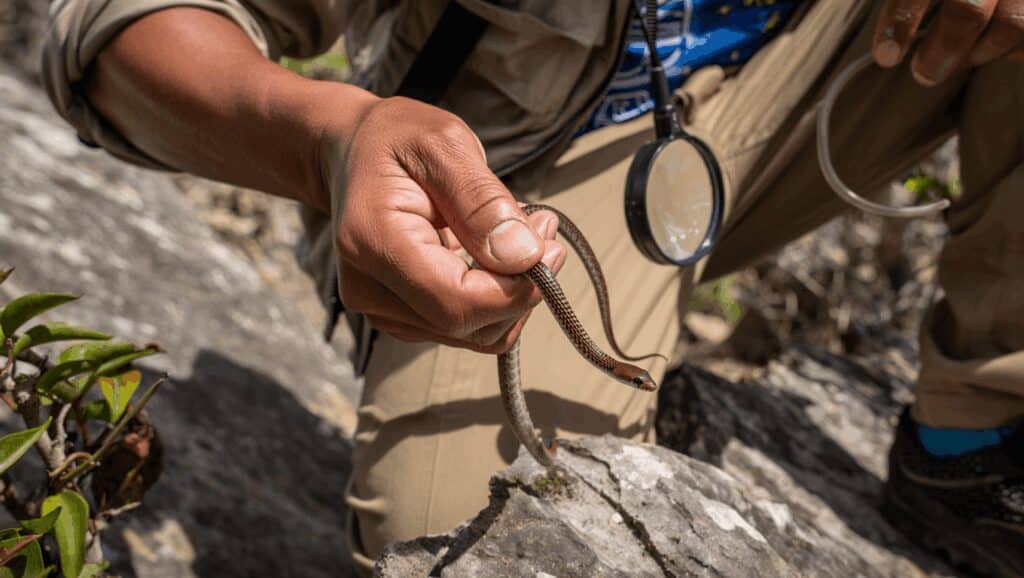
Hidden beneath a weathered rock in central Barbados, researchers recently spotted one of the planet’s tiniest reptiles — a snake so small it has long eluded scientists. The rediscovery during a focused field survey has renewed interest in the island’s unique fauna and raised new concerns about the future of its fragile habitats.
For nearly two decades this species had not been confirmed by scientists; now its reappearance shines a light on why remote, overlooked places still matter for biodiversity and how careful fieldwork can turn up surprises.
How the rediscovery unfolded during a targeted island survey
The Growing Demand for Data-Driven Decision Making in Silicon Valley
He quit, ran out of money, and begged to come back — here’s how his boss reacted
Teams from the Barbados Ministry of the Environment and Beautification were carrying out the Conserving Barbados’ Endemic Reptiles (CBER) project, scanning native forest fragments and gullies for rare reptiles when they found the tiny serpent. Field officers spent months searching for several island-endemic species before a single overturned stone revealed what they were looking for.
Project officer Connor Blades and Re:wild Caribbean program officer Justin Springer were among the surveyors who turned over rocks, sifting through leaf litter and soil. Their persistence paid off when they pulled up a rock near a tree root and discovered an earthworm — and a snake no larger than a grown-apple.
Springer recalls the moment as equal parts disbelief and relief: after years of scanning and rarely finding anything, the team suddenly had an animal in hand. Blades took the specimen to the University of the West Indies for a closer look under a microscope to confirm the identification.
Meet the Barbados threadsnake: the tiniest of its kind
The snake is the Barbados threadsnake (Tetracheilostoma carlae), often described as the smallest snake species known. Adults reach roughly 3 to 4 inches long (about 9–10 centimeters), putting them at the minimum size possible for a functional snake. Because of their size and secretive habits, sightings are rare and sporadic.
Distinctive features noticed by researchers
- Delicate pale-orange dorsal lines running from head to tail
- Eyes positioned on the sides of the head rather than prominent forward-facing eyes
- A rostral scale at the tip of the snout
- Absence of gland lines on the head
These traits set the threadsnake apart from look-alike species. In Barbados, it can be mistaken for the invasive Brahminy blind snake (also called the flowerpot snake), which has become more common on the island in recent decades.
Why this tiny snake is so hard to find
Threadsnakes are fossorial — they spend most of their life underground or beneath debris — and lack the bright colors or bold behavior that make many reptiles easy to spot. Their cryptic lifestyle explains the long gaps between confirmed records; only a handful of verified sightings exist since the species was first described in the late 19th century.
Blades explained that identifying the threadsnake often requires microscopic examination because, to the naked eye, it can appear nearly identical to small introduced blind snakes. That need for close inspection, combined with overall rarity, means many individuals go undetected.
Where these snakes live and why their habitat matters
Suitable forest habitat is limited on Barbados. Patches of native forest remain mostly within the rugged Scotland District and in a network of gullies that dissect the island. These pockets act as important biological reservoirs for endemic plants and animals, including the threadsnake.
- Limited forest area increases the risk of population isolation
- Fragmentation can make it difficult for individuals to find mates
- Human-driven habitat degradation threatens the ecological integrity of these refuges
Protecting these forest remnants is essential not only for the threadsnake but also for other species that depend on intact microhabitats and the island’s natural heritage.
Conservation implications and the role of search efforts
Before this recent encounter, the Barbados threadsnake had been listed among thousands of species cataloged by Re:wild’s Search for Lost Species initiative — organisms that have not been verified for years or decades. Rediscovery does not remove conservation concerns; instead, it underscores the need for ongoing monitoring, habitat protection, and research into the species’ ecology.
Field teams emphasize that every confirmed sighting provides critical information: where the snake persists, what microhabitats it uses, and how dense its populations may be. That data helps guide conservation measures and land-management decisions.
What comes next for the island’s tiny serpent
After verification at the university, researchers returned the snake to the forest where it was found, a standard practice that minimizes stress and avoids removing rare animals from their environment. Ongoing surveys under the CBER project will continue to search for additional individuals and map the species’ distribution in hopes of better understanding its population status.
For conservationists, the threadsnake’s reappearance is both a success and a reminder: small, hidden species can survive for years in narrow refuges, but their long-term persistence depends on human choices about land use, restoration, and protection of the island’s remaining native forests.
You might also like:
- 158 giant endangered tortoises released on Galápagos island after being extinct for 180 years
- Endangered iguanas leave protected Caribbean island, populations explode
- Snail breeding and reintroduction: scientists launch largest effort to save species thought extinct
- Galapagos rail missing for 200 years reappears after Floreana island restoration
- Zoo saves 21 snails from extinction, returns hundreds to pristine Atlantic island

Michael Thompson is an experienced journalist covering U.S. and global news. With ten years on the front lines, he breaks down political and economic stories that matter. His precise writing and keen attention to detail help you grasp the real‑world impact of every event.


I swear, Ive seen longer earthworms in my grandmas garden than this Barbados threadsnake! Nature never fails to amaze with its tiny wonders. Makes you wonder what else is out there waiting to be rediscovered, right?
Man, I always knew Barbados was hiding some cool stuff! Like, this tiny snake is the ultimate hide-and-seek champ. Its so small, its practically invisible! Props to those researchers for finding something tinier than my patience during rush hour.
Man, talk about sneaky lil fellas! This Barbados threadsnake must be the ninja of the snake world if its so hard to spot. Like, how do you even rediscover something thats basically a living piece of spaghetti? Natures full of surprises, I tell ya.
Dang, that Barbados threadsnake sounds like a real sneaky noodle ninja! Imagine trying to find that lil guy slitherin around like a stealthy spaghetti strand. Nature be playin hide and seek with us, huh? Who knew a snake could pull off disappearing acts like that!
Man, talk about finding a needle in a haystack! I mean, a snake in Barbados! Props to the researchers for spotting that tiny threadsnake after 20 years. Natures full of surprises, aint it?
Man, I swear Natures playing hide and seek with us. Like, how do you lose a whole snake for 20 years, only to find it again on some random island? Barbados, you sneaky little place. Bet youre hiding more surprises in those palm trees!
Man, I remember learning about those Barbados threadsnakes back in the day. Twenty years later, they pop up like, Surprise, were still here! Talk about stealth mode. Wonder what other tiny critters are playing hide-and-seek out there.
Man, I remember the buzz when they first found this tiny snake in Barbados. Took em 20 years to spot it again! Natures full of surprises, aint it? Makes you wonder what else were missing out there.
Oh man, I totally get that thrill! Natures like a never-ending treasure hunt, huh? Always surprising us with its hidden gems. Makes you wonder what other little critters are playing hide and seek out there, right?
Man, can you believe it? This lil snake was MIA for 20 years, and now its back in the game! Barbados must be partying hard. Who knew such a tiny creature could cause such a stir? Natures full of surprises, huh?
Man, talk about a sneaky little guy! Its wild how this tiny snake managed to stay hidden for so long. Makes you wonder what other critters are out there, flying under the radar. Natures full of surprises, aint it?
Geez, talk bout a sneaky snake! This lil fella hid for 20 years in Barbados? Mustve been playin hide and seek like a champ. Props to the researchers for crackin the code!
No way, that sneaky snake was on a whole other level of hide-and-seek! Mustve had a secret cheat code or somethin to pull off a 20-year vanishing act in Barbados. Kudos to the researchers for finally busting the little Houdini!
Man, talk bout a needle in a haystack! This lil Barbados threadsnake playin hard to get, huh? Props to them researchers for trackin it down after two decades. Natures full of surprises, I tell ya!
Dang, talk about a mission impossible! This Barbados threadsnake really be playing hide and seek like a champ. Gotta give it up to those researchers for not givin up for two whole decades. Natures like a mystery box, eh? Always keeps ya guessin!
Man, this Barbados threadsnake is playing hide-and-seek like a pro! Twenty years lost and now its back in the spotlight. I bet its laughing at us with those tiny scales and elusive moves. Sneaky little fella!
Man, talk bout a needle in a haystack! This lil Barbados threadsnake playin hide and seek for 20 years. Props to the researchers for crackin the code on findin this sneaky noodle!
Man, can you believe it? 20 years later and they find this teeny snake in Barbados? Its like a real-life mystery movie! Props to the researchers for their eagle eyes, but seriously, how did they even spot that lil guy?