
Show summary Hide summary
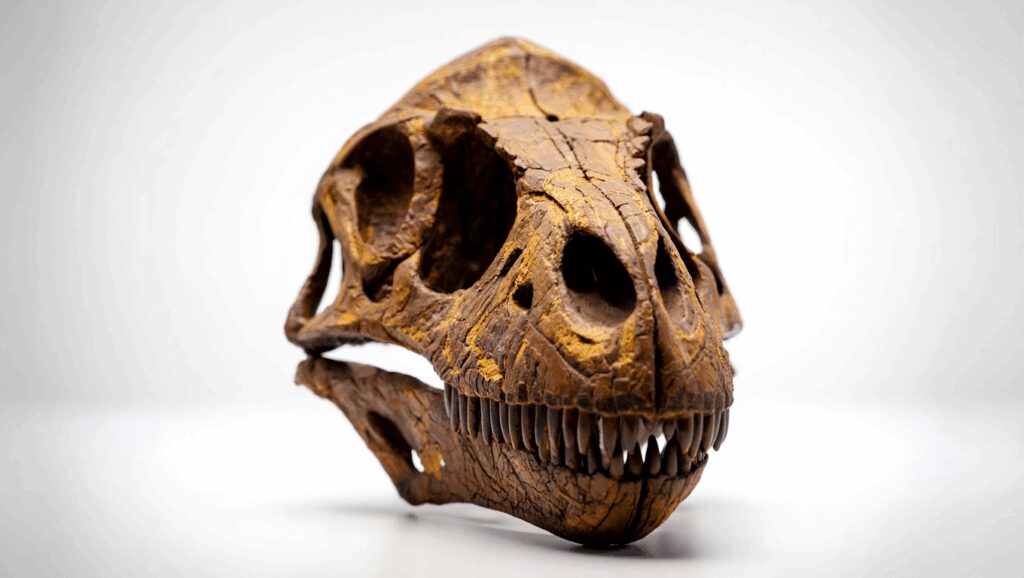
A remarkably preserved dinosaur fossil pulled from Mongolia’s Gobi Desert is rewriting what paleontologists thought they knew about dome‑headed dinosaurs. The specimen, named Zavacephale rinpoche, arrives as both the most intact and the oldest member of its group yet identified — a compact, muscular animal with a thick, rounded skull that may have been built for impact.
At roughly three feet long and about 13 pounds in life, this small Cretaceous dinosaur preserves bones rarely seen together in one find. The fossils include an undistorted skull, parts of the hands and tail, and even digestive stones, offering a rare window into anatomy and behavior for a lineage usually known only from broken dome fragments.
The Growing Demand for Data-Driven Decision Making in Silicon Valley
He quit, ran out of money, and begged to come back — here’s how his boss reacted
Where and when the fossil was found — and why it matters
Paleontologist Tsogtbaatar Chinzorig and his team excavated the specimen from the Khuren Dukh Formation in Mongolia, and researchers have dated it to about 108 million years old. That age pushes back the known timeline for pachycephalosaurs by roughly 14 million years compared with the next oldest example, making Zavacephale a pivotal early member of the group.
The find was detailed in the journal Nature, where scientists note that this specimen’s combination of age and completeness fills a substantial gap in the fossil record. In practical terms, the discovery provides a new anchor point for understanding how dome‑headed dinosaurs developed through the mid‑Cretaceous.
What the skeleton includes: an unusually complete pachycephalosaur
Most pachycephalosaur discoveries consist of partial skull caps and scattered fragments. This specimen is different. It preserves multiple element types that paleontologists rarely see together, which allows for a more holistic reconstruction of form and possible function.
- Skull: an undistorted, nearly complete cranium with a well‑formed dome
- Postcranial material: tail vertebrae and limb bones that illuminate body proportions
- Forelimb bones: hand elements that had not been described for similar species before
- Gastroliths: stomach stones that hint at digestive behavior
Because the bones are preserved in articulation and do not show the usual crushing or warping, researchers can run detailed scans and biomechanical tests that were previously impossible for many pachycephalosaurs.
Behavioral clues: headbutting, display, or something in between?
Pachycephalosaurs have long inspired debate: were their domes used as battering rams, or were they elaborate display structures? The new specimen complicates and enriches that conversation. Its dome is already well developed in what appears to be an adolescent individual, which suggests that the structure formed early in life.
Early dome development can be read a few ways: it might indicate involvement in social behaviors such as dominance contests or mate competition at younger ages, or it could reflect selection for visual signaling in teenaged animals. The fossil’s combination of cranial thickness with intact facial bones gives scientists physical parameters for testing impact loads and stress patterns in the skull.
CT scanning the dome: surprising bone architecture
High‑resolution CT scans of the skull show that Zavacephale’s dome is composed primarily of frontal bones rather than the mixture of bones seen in some later species. This anatomical detail matters because it reveals an early developmental pathway for dome formation that differs from subsequent pachycephalosaurs.
Why frontal‑dominant domes matter for evolution
Bone composition affects both the mechanical properties of the dome and how it could grow and remodel during the animal’s life. A frontal‑heavy dome suggests that, in the lineage leading from early to later pachycephalosaurs, there were shifts in which skull bones expanded and contributed to the impact‑resistant cap. In other words, Zavacephale offers a snapshot of an evolutionary experiment in cranial construction.
What scans tell us about function
The internal structure visible on CT permits computer models that estimate how forces would travel through the skull. These models can test competing ideas — from blunt‑force collisions to less forceful displays — by simulating stresses on the dome and the rest of the head. Because this skull is undistorted and preserves internal architecture, those simulations will be more reliable than earlier efforts based on fragmentary material.
Broader scientific implications and research directions
Beyond settling details of cranial anatomy, the find reshapes timelines and ancestral relationships within the pachycephalosaur family. By pushing the group’s record back in time, Zavacephale challenges previous models about when and where key traits evolved, and it will force revisions of phylogenetic trees and biogeographic histories.
- Researchers will reexamine related fossils to see if early dome characteristics were previously overlooked.
- Paleobiologists will use the gastroliths and limb bones to refine ideas about diet and locomotion.
- Biomechanicalists will combine CT data with 3D modeling to test head‑impact scenarios under realistic conditions.
As teams around the world analyze the specimen’s anatomy, microstructure, and context within the Khuren Dukh Formation, Zavacephale rinpoche is already proving to be a keystone discovery that will inform studies on dinosaur growth, social behavior, and the evolutionary pathways that produced one of the most distinctive skull shapes in the Mesozoic fossil record.
You might also like:
- Gobi Desert fossil discovery upends timeline of mammal evolution
- Megaraptor fossil found with ancient crocodile in its mouth
- Ancient snake found in London museum: what we know
- 90-million-year-old missing link fossil of tiny bird-like dinosaur discovered
- Triceratops huge nose helped regulate body temperature, study suggests

William Anderson is a multimedia producer specializing in videos, podcasts, and interactive galleries. With five years of immersive content creation, he turns information into a rich audio‑visual experience. His storytelling skills draw you directly into the heart of every story, on any platform.


I used to think pachycephalosaurs were all about headbutting. Now this skull discoverys got me like, Wait, maybe they were into dome displays too? Who knew these dinos had a whole fashion statement going on!
Man, I remember when I was a kid, dreaming about digging up dino bones. Now theyre flipping the script on pachycephalosaurs? Its like a real-life Jurassic Park plot twist. Cant wait to see what other surprises paleontology has in store!
Man, totally get you! Digging up dino bones used to be the ultimate childhood dream, right? Now, with paleontology dropping these plot twists, its like were living in a real-life Jurassic Park sequel! Cant wait to see what other mind-boggling discoveries are around the corner. The dinosaur world keeps us on our toes for sure!
I mean, talk about a dino twist! This skull finds like the plot twist of the paleo world. Can you imagine these pachycephalosaurs headbutting with those thick domes? Natures fight club, yo!
Dude, imagine those dome-headed dinos headbutting for real! This skull discoverys like a plot twist in a dino movie! Cant wait for the sequel: Pachycephalosaur Smackdown!
Man, this skull discoverys wild! Makes me rethink these dome-headed dinos. Imagine those headbutts…ouch! CT scanning bones? Science is on fire! Cant wait for more dino surprises!
Whoa, didnt think Id be getting a crash course on dome-headed dinos today! This skull discoverys like finding out your favorite bands got a secret album. Cant wait to see how this flips the script on pachycephalosaurs!
Man, who knew pachycephalosaurs were into extreme headbutting? This skull discoverys like a plot twist in a dino soap opera. Cant wait for the next episode—will they kiss and make up or go full-on Jurassic Park on each other?
Man, I always thought those dome-headed dinos were just thick-skulled bullies, but this skulls got me rethinking! Imagine these pachycephalosaurs struttin around, headbutting or showin off with those fancy domes! Wild stuff, man.
Man, this totally flips my dino knowledge upside down! Imagine these pachycephalosaur dudes headbutting with those bizarre skulls! Cant wait to see more mind-blowing revelations from these CT scans!
Man, aint this the plot twist of the century! Who knew pachycephalosaurs were hiding such skull secrets? Wonder if they were using those domes for headbutting or just to look cool at dino parties.
Man, those pachycephalosaurs are wild! Who knew their skulls were such a big deal? Bet they were the real headbangers of the dino world. Can you imagine the domes on those creatures? Crazy stuff!
Dude, totally feel you on that! Those pachycephalosaurs were like the rockstars of the dino world, slamming those thick skulls around! Mustve been epic headbanging sessions back in the day. And yeah, can you imagine the size of those domes? Insane! Nature really went all out with those bad boys.
Man, I always thought pachycephalosaurs were just hard-headed dinos! But this skull discovery blows my mind. CT scanning the dome? Thats next-level paleo forensics. Cant wait to see what else they dig up!
Man, these dome-headed dinos are wild! Imagine headbutting with a skull like that. This new find is like a plot twist in a dinosaur movie nobody saw coming. Natures full of surprises, aint it?
Yo, for real, those dome-headed dinos are on another level! Imagine headbutting with a skull like that, talk about a knockout punch! This new discovery is like a total curveball in a dino flick, right? Natures got more twists than a soap opera, man.