
Show summary Hide summary
- How the fabricated police report surfaced and spread
- Why AI models produce believable—but false—official documents
- Practical steps journalists and citizens can use to verify suspicious reports
- Legal and reputational fallout from falsified official records
- What law enforcement and public agencies can do to protect records and trust
- How technology companies and researchers are responding
- Tips for individual readers to avoid spreading false official documents
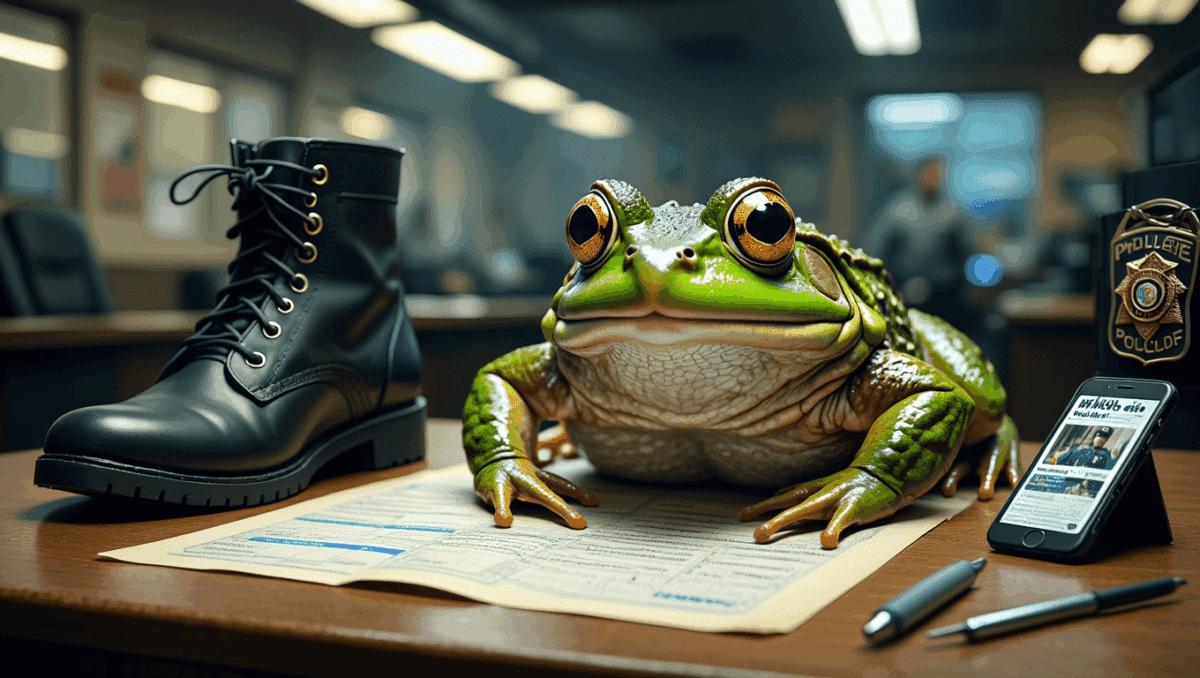
A wildly inaccurate police report claiming an officer “transformed into a frog” spread across social platforms this week, catching the attention of journalists and the public alike. What began as a surreal social media post quickly revealed a more serious story: an AI-generated document masquerading as an official report, raising fresh concerns about how synthetic content can erode trust in institutions.
The episode forced local authorities to publicly deny the claim, while technologists and open-source investigators traced the bogus file to a generative model. Beyond the humor of the headline, experts warn the incident underscores growing risks as AI tools become capable of producing convincing but false official records.
How the fabricated police report surfaced and spread
The Growing Demand for Data-Driven Decision Making in Silicon Valley
He quit, ran out of money, and begged to come back — here’s how his boss reacted
The fake report first appeared on a community messaging app and was shared widely on microblogging platforms. Early posts included screenshots showing an official-looking letterhead, incident codes, and a narrative that described the improbable event in authoritative, bureaucratic language.
- Users who saw the document reacted with disbelief and amusement, which helped the file go viral.
- Local journalists contacted the department for confirmation; the police department issued a statement calling the document a hoax.
- Digital sleuths later traced the file’s provenance to content produced by a generative AI model, not an official records system.
The speed of distribution illustrated how synthetic documents can leverage social sharing to reach large audiences before verification.
Why AI models produce believable—but false—official documents
Large language models and multimodal generators are trained to mimic patterns in text and visuals, including how government reports are formatted and phrased. They do not have an innate understanding of truth; instead, they assemble plausible tokens and visuals based on training data.
Common mechanisms behind these AI “hallucinations”
- Pattern matching: Models reproduce common report structures—headers, dates, incident numbers—because those elements frequently appear in their training sets.
- Lack of source grounding: The models don’t access official databases to confirm facts, so invented details can appear authoritative.
- User prompts: Malicious or playful prompts can steer models to fabricate realistic-looking documents.
Because the output can be richly detailed and formatted, readers may assume authenticity unless they take steps to verify the document’s origin.
Practical steps journalists and citizens can use to verify suspicious reports
When you encounter an official-sounding document online, these verification practices reduce the chance of being misled:
- Check the source: Look for the document on the agency’s verified website or official social media channels.
- Contact the agency directly: Call or email the press office listed on an official page rather than relying on information contained in the questioned document.
- Inspect metadata and file properties: File creation dates, author fields, and modification histories can reveal inconsistencies.
- Compare formats: Authentic police reports often follow strict templates—mismatched fonts, odd spacing, or wrong terminology can be red flags.
- Use reverse-image searches: If a document includes graphics or letterheads, reverse-image tools can show if those assets were reused from other contexts.
- Look for digital signatures or secure stamps: Many agencies now embed cryptographic signatures or watermarks to help validate documents.
Verification is most effective when multiple checks point in the same direction, rather than relying on a single indicator.
Legal and reputational fallout from falsified official records
Fake official documents can cause tangible harm—misleading the public, damaging an individual’s reputation, or prompting unnecessary emergency responses. Legal experts say existing defamation and fraud laws apply in many cases, but prosecution can be complicated when content originates from anonymous users or offshore servers.
- Targeted false records can lead to doxxing, harassment, or false accusations against officials or private citizens.
- Victims may pursue civil remedies, but litigation is often costly and slow compared with the rapid spread of misinformation online.
- Platforms face pressure to act quickly, but content takedowns raise complex free-speech and moderation debates.
What law enforcement and public agencies can do to protect records and trust
As AI-generated forgeries get more sophisticated, agencies must adapt. Several practical measures can reduce confusion and strengthen public confidence.
Recommended steps for agencies
- Adopt secure document practices: Use digital signatures, authenticated portals, and tamper-evident formats for official releases.
- Communicate proactively: Maintain easily searchable archives of authentic reports and clear channels for public verification.
- Train staff and spokespeople: Ensure rapid, consistent responses to misinformation and establish protocols for confirming or denying circulated documents.
- Partner with tech platforms: Work with social networks to fast-track takedowns of demonstrably false official records and to flag questionable content.
How technology companies and researchers are responding
Developers of generative AI are experimenting with safeguards—watermarking outputs, offering provenance metadata, and building detection tools—but the arms race between synthesis and detection continues.
- Some firms are embedding invisible markers that signal content was AI-generated.
- Academic teams and startups are creating forensic tools to identify manipulated files and synthetic documents.
- Policy proposals call for clear labeling of AI-generated content and for liability rules around impersonation of public institutions.
None of these solutions is a silver bullet, which is why a combination of technological, legal, and institutional responses is likely to be required.
Tips for individual readers to avoid spreading false official documents
- Pause before sharing: Viral appeal often precedes verification—take a moment to check sources.
- Look for confirmations from multiple reputable outlets or the agency named in the document.
- Flag suspicious content to the platform and, if appropriate, to the institution purported to have produced the file.
- Be skeptical of sensational claims that lack corroboration, even when the formatting looks credible.
You might also like:
- AI-generated NWS map hallucinates fake towns in Idaho
- Jamie Michael jailed after social media post about Southport
- Assassination claim denied as sinister lie by officials
- Maccabi Tel Aviv ban justified by police fake claims
- Epstein scandal: is media coverage turning into a moral panic?

William Anderson is a multimedia producer specializing in videos, podcasts, and interactive galleries. With five years of immersive content creation, he turns information into a rich audio‑visual experience. His storytelling skills draw you directly into the heart of every story, on any platform.


Man, AI going all sci-fi on us with cops turning into frogs? Next thing you know, RoboCop will be RoboFrog. Gotta stay woke and fact-check these wild stories cause truths weirder than fiction!
Man, that AI-thing is cookin up wild stuff. Imagine a cop hoppin around as a frog! Gotta watch our backs with these tech shenanigans. Cant trust everything we read nowadays, gotta stay sharp, yknow?
Man, tell me ‘bout it! These AI creators are straight-up wildin’ with their ideas. A cop as a frog? That’s some next-level stuff right there. Better keep an eye out for them tech shenanigans, ain’t no tellin’ what they’ll come up with next. Trust? Ha, that’s a rare commodity these days. Stay woke, my friend, stay woke.
Man, imagine if cops actually morphed into frogs! That reports wild. AI goofed big time. Gotta stay sharp cause fake news spreads like wildfire. Cant trust everything, gotta dig deeper.
Man, can you imagine the chaos if cops could really morph into frogs? Fake reports spreading like gossip at a high school prom. Better double-check sources, folks, before we end up believing in some ribbiting nonsense!
Man, that AI-generated police report turning an officer into a frog is wild. Reminds me of the time I tried to prank my buddy by photoshopping him into a unicorn. Technologys messing with reality, I tell ya!
Imagine if ya read a police report bout an officer morphin into a frog, wild, right? AI makin up these tales, makin us all scratch our heads. Gotta watch what we trust these days, real or ribbit?
Aint that the wackiest thing Ive heard all week! Imagine a cop turning into a frog, ribbiting their way outta trouble. AIs spinning crazier yarns than my grandma at bingo night. Trust issues, man, theyre realer than ever. Whos next, a squirrel lawyer?
Man, AIs gone too far this time. Imagine a cop ribbiting away, hilarious! But hold up, gotta watch out for these fake reports. Cant believe everything that pops up online, gotta fact-check like a pro.
Mate, imagine the chaos if the AI mix-up made Kermit the prime suspect? Its not easy being green would take a whole new meaning in that precinct! But seriously, we gotta watch out for these tech glitches, theyre getting too wild.
Man, this AI-generated police report drama got me reelin. Imagine a cop actually turnin into a frog! Who comes up with this stuff? Like, did they really believe people would buy into that ribbitin tale? Crazy times we live in, I tell ya.
Yo, I feel ya, man! This AI stuff is wildin out! Can you even picture a cop hoppin around as a frog? Like, what even?! Whos cookin up these wacky ideas, right? People fallin for that? *ribbit ribbit* Its like a whole new level of cray-cray were livin in. Gotta love the creativity, even if its leapin into the absurd, huh?
Man, that AI report makin me think of that time granny swears she saw a UFO. But a cop turnin into a frog? Sound like a fairytale gone wrong. Gotta watch out for them fancy bots!
Man, this whole frog-cop things wild! Reminds me of that time in high school when I convinced everyone our principal was a shape-shifting alien. AIs got jokes, huh? Gotta double-check those reports, folks!
Man, I thought my typos were bad, but AI turning cops into frogs? Thats some wild fiction! Gotta double-check everything now. Cant trust a report these days, not even if Kermits involved!
Man, this AI stuff is gettin wild! Imagine a cop morphin into a frog on official records? Sounds like a fantasy flick gone wrong. Gotta watch out for those hallucinations before we all start ribbiting.
Man, this whole frog fiasco got me reminiscin bout that sci-fi flick where aliens disguised as humans cause chaos. AIs spittin out wild tales now? Better trust the good ol human brain to sniff out these shenanigans.
Man, this whole AI-generated police report thing is like a bad sci-fi flick coming to life! Next thing you know, theyll be telling us the aliens are real. Who needs Hollywood when youve got AI spinning froggy tales?
I mean, imagine the chaos if folks start takin AI-generated stuff at face value. One sec youre a cop, next youre a frog? Its like a digital fairytale gone rogue. Gotta stay woke, peeps!