
Show summary Hide summary
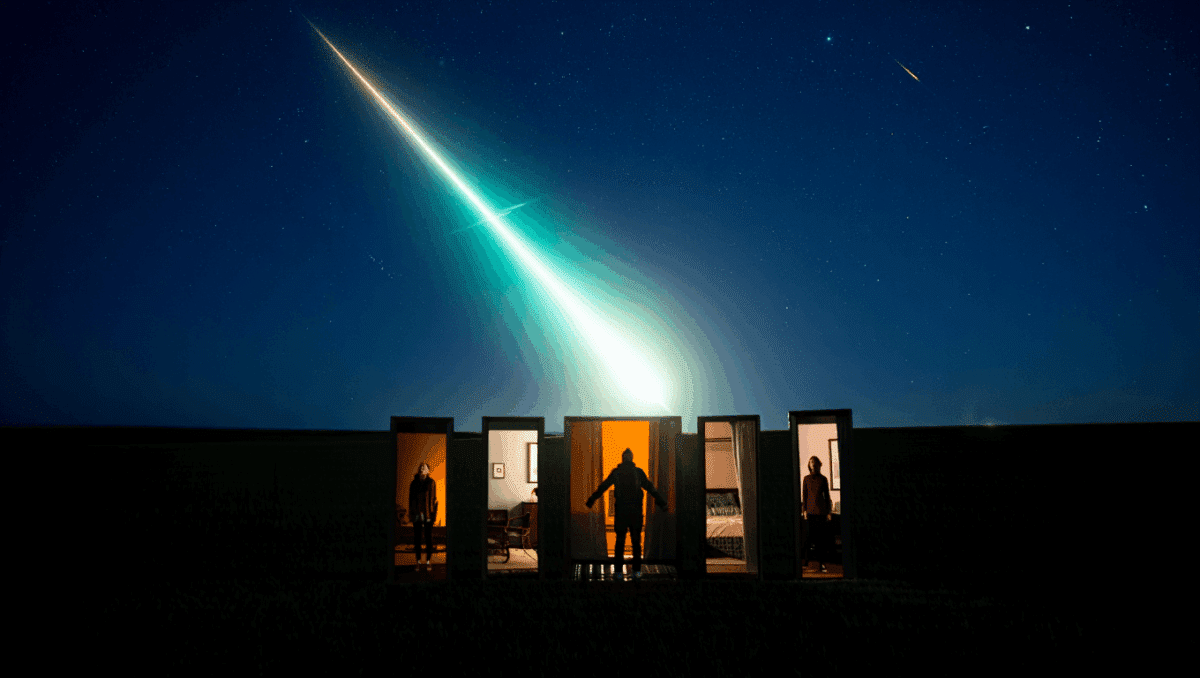
The night sky over the central United States tore open for a few electrifying seconds as a brilliant white-green streak blazed from horizon to horizon. People in doorways, behind steering wheels, and in living rooms across several states grabbed phones and pointed cameras skyward — and for a short, shared moment everyone watched the same otherworldly flash.
Within minutes clips circulated online: shaky smartphone videos, doorbell camera captures, and dashboard recordings that missed the start by a heartbeat but caught the flare. The object vanished almost as fast as it arrived, leaving behind questions, awe, and a stack of eyewitness reports that pointed to one clear possibility: a meteor so bright it earned the label people keep calling it — a fireball.
Eyewitness accounts and the trail of footage that crossed state lines
The Growing Demand for Data-Driven Decision Making in Silicon Valley
He quit, ran out of money, and begged to come back — here’s how his boss reacted
Cameras and onlookers in at least five states reported the same phenomenon. The collective stream of observations created a near-continuous record of the event, from the first flash to the moment the object broke apart.
- Where it was seen: Illinois, Indiana, Kentucky, Ohio, and Wisconsin registered sightings and videos from the event.
- How it was captured: Dashcams, home security devices, and doorbell cameras supplied the bulk of the recordings.
- Public response: The American Meteor Society collected more than one hundred reports, a mix of formal submissions and social posts linked to dozens of videos.
How NASA mapped the meteor’s flight through our atmosphere
Scientists pieced together the trajectory using eyewitness accounts and publicly available camera feeds. Their reconstruction reveals a brief but dramatic descent that lit up the night in multiple states.
Key technical details from the agency’s analysis
- Initial sighting altitude: Around 48 miles above the ground near Trinity, Indiana.
- Speed: The object traveled at roughly 29,000 miles per hour.
- Path length in atmosphere: Approximately 48 miles before visible disintegration.
- Break-up altitude: Estimated near 27 miles above Laura, Ohio.
NASA classifies especially bright meteors as fireballs, typically those that equal or exceed a brightness magnitude of about -3. On that scale, lower numbers mean greater brightness, so a negative magnitude signifies a spectacle far brighter than an ordinary shooting star.
Was this part of a meteor shower? Experts say no
Despite the drama, officials were quick to point out that this was not a scheduled meteor shower. The event appears to have been a random encounter — a single fragment crossing Earth’s atmosphere rather than a predictable stream of debris linked to a comet.
Why astronomers think this was a lone asteroid fragment
- Cometary fragments typically hit the atmosphere at higher velocities; this object’s relatively slower speed aligns with characteristics of asteroid debris.
- The reconstructed path and fragmentation pattern are consistent with a compact rock fragment heating and breaking apart as it encountered denser air.
Could pieces have survived to reach the ground?
When space rocks enter the atmosphere they undergo intense heating and stress, which often causes them to fragment and vaporize. Because this object broke up tens of miles above the surface, most of it likely burned up. Still, small fragments — called meteorites — can sometimes survive and reach the ground.
- If any fragments remained intact, they would probably be small and scattered across a wide area.
- Finding meteorites requires targeted searches and a bit of luck; local authorities or universities sometimes help coordinate recovery efforts when viable fall zones are identified.
Why a single streak of light became a viral moment
The meteor’s path crossed modern technology as quickly as it crossed the sky, producing an instant, crowd-sourced archive of the event. A handful of factors explain the rapid spread of clips and reports.
- Pervasive cameras: Doorbell and dash cameras now record continuously, turning private properties into a distributed observation network.
- Social sharing: One person’s upload creates a domino effect — others check their phones, upload, and compare timestamps and angles.
- Shared experience: Celestial events tap into a communal curiosity; people naturally compare notes and seek explanations.
For a few seconds, strangers across multiple states experienced the same vivid reminder that Earth is orbiting inside a dynamic and sometimes surprising neighborhood of space rocks and dust.
You might also like:
- Asteroid could hit the moon in 2032: what we know
- Meteor shower peaks in January as bright supermoon outshines the night
- Photographer captures mysterious lights over Italian town for second time
- July meteor showers: two peaks to light up the late July night sky
- Florida man arrested for public sexual act with vacuum cleaner

William Anderson is a multimedia producer specializing in videos, podcasts, and interactive galleries. With five years of immersive content creation, he turns information into a rich audio‑visual experience. His storytelling skills draw you directly into the heart of every story, on any platform.


Man, saw that fireball mess in the Midwest sky! Reminded me of that time I thought aliens were invading. NASA breaking it down like CSI is wild. Imagine if meteor showers were like, actual showers? *laughs*
I remember when I saw a meteor shower as a kid. It was like natures own fireworks show. Reading about this Midwest meteor, its wild how these cosmic events still captivate us all. Natures got the best special effects!
Man, meteor showers are like Mother Natures own light display, right? I had this crazy memory as a kid, watching those shooting stars like it was the coolest show on earth. Its wild how these cosmic events still pull us in, even as adults. Natures got the best effects team in the universe, hands down!
Man, that meteor show was wild! Reminds me of that sci-fi movie where aliens invade Earth. Crazy how NASA tracks those things. Makes you think were just tiny specks in the universe, huh?
Man, I remember seein a meteor once. Lit up the whole dang sky, felt like somethin outta a movie. Crazy how the Midwest got its own show now. Natures fireworks, I tell ya.
Dang, that meteor show mustve been a sight to see! Mother Nature really knows how to put on a show, huh? Makes you wonder what other surprises shes got up her sleeve. Ever catch anything else cool in the night sky?
Man, I remember when I saw a bright fireball streak across the sky when I was a kid. Thought it was aliens, haha! These meteor events always spark wild theories. Cant wait to hear the conspiracy chatter on this Midwest sighting!
Dude, that meteor show was lit! Reminds me of that time I saw a shooting star while camping. Crazy how NASA tracks these things. Wonder if aliens are just playing cosmic darts up there #outtathisworld.
Man, that meteor was like a free fireworks show in the sky! Reminds me of that time I saw a shooting star with my ex. Wish I couldve caught the Midwest meteor on camera, wouldve gone viral for sure!
Man, I remember seeing a meteor shower when I was a kid. Lit up the whole sky, felt like magic. Crazy how this one in the Midwest went viral. Natures light show, eh?
I remember seein a meteor shower once, looked like fireworks in the sky. This Midwest fireball, though? Crazy stuff. NASAs breakdown is like watchin a detective show, but with space rocks. Mind-blowin!
Man, that meteor show was lit! Reminds me of that time I saw a shooting star with my crush. NASAs breakdown is like a sci-fi movie, real-life Armageddon stuff! Cant believe we missed out on a meteor shower, though. Next time, count me in!
Man, that meteor show was like a scene from a sci-fi flick! I felt like I was watching Independence Day live in the Midwest. Anyone else waiting for Will Smith to pop out and save the day?
Man, that giant fireball in the Midwest was like straight outta a sci-fi flick! Imagine seein that live, talk about a show! Wonder how NASA tracks these things. Bet they got a real-life space detective squad or somethin.