
Show summary Hide summary
- Why the Kon-Chukurbashi ice cap stands out in a warming world
- How the team recovered 30,000 years of frozen climate records
- International teamwork: who joined the expedition
- Early surprises in the cores: dust layers and strange discoloration
- What the findings could mean for glacier preservation research
- Next steps and ongoing investigations
A single glacier in Tajikistan is bucking a global trend: while most mountain ice is retreating, this high-altitude ice cap appears to be gaining mass. That surprising pattern drew an international research team to the Pamir Mountains, where scientists have just hauled up decades — and perhaps millennia — of frozen history to try to decode how and why this glacier survived.
Their prize: cylindrical ice cores that capture roughly 30,000 years of atmospheric and environmental signals. Packed into insulated trays and flown out by helicopter, these samples may hold clues that could reshape how we think about preserving mountain glaciers as the planet warms.
Why the Kon-Chukurbashi ice cap stands out in a warming world
The Growing Demand for Data-Driven Decision Making in Silicon Valley
He quit, ran out of money, and begged to come back — here’s how his boss reacted
Most of the world’s mountain glaciers have been shrinking for decades, from the Himalayas to the Andes. The Kon-Chukurbashi ice cap, high in the Pamir range of Central Asia, is an exception. Instead of steadily thinning, records and satellite imagery indicate it has grown in recent decades — an anomaly that has scientists asking whether local climate, snowfall patterns, wind-driven accumulation, or other processes are at work.
Scientists believe understanding this one glacier could shed light on mechanisms that help ice persist elsewhere. That prospect prompted a multinational team to mount a risky field campaign to extract long ice cores and transport them to laboratories for analysis.
How the team recovered 30,000 years of frozen climate records
Ice cores act like time capsules. As snow compresses into ice year after year, it locks in tiny chemical markers, airborne dust, and trapped air bubbles that preserve information about past temperatures, precipitation, volcanic eruptions, and even human activity.
Field work and logistics
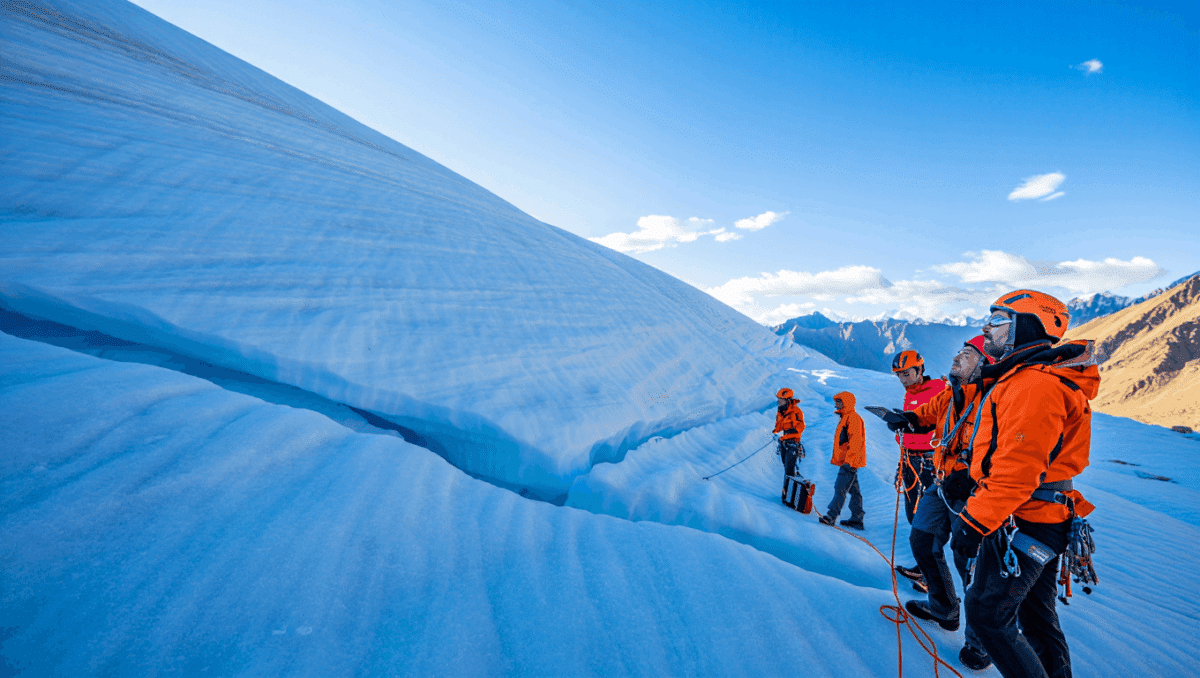
- Scientists drilled down about 100 meters into the ice, removing cores roughly the size of a soda can in 20-inch segments.
- Cores were placed in insulated trays, carried by researchers to a waiting 4×4, and then moved into refrigerated trucks for safe transfer.
- Samples were split between research institutions, including the Institute of Low Temperature Science at Hokkaido University and a Swiss climate institute, with long-term storage supported by the Ice Memory Foundation.
The retrieved sequence likely spans some 30,000 years, offering a continuous record that researchers can slice into annual and multi-decadal signals once laboratory work begins.
International teamwork: who joined the expedition
The operation brought together glaciologists from Tajikistan, Russia, Switzerland and Japan, reflecting the high level of coordination needed for remote, high-elevation research. Funding and logistics involved both academic institutions and nonprofit efforts that preserve ice archives for future study.
- Local mountaineers and logistics crews guided access and safety on the steep terrain.
- Scientific teams handled drilling, sampling, and initial field-based analyses.
- Ice Memory and partnering labs organized cold-chain transport and long-term preservation.
Early surprises in the cores: dust layers and strange discoloration
Initial, rapid inspection of the upper sections of the cores happened in the field, where researchers noted relatively clean ice near the surface. But at greater depths — below around 70 meters — the ice became increasingly laden with dust and particulates. The deepest five meters showed a distinct yellow hue that researchers described as unusual for the region.
The presence of thick dust bands and yellow-stained ice raises new questions. These layers could reflect intense past dust storms, volcanic deposits, or regional environmental shifts, each of which would tell a different story about past climate and atmospheric circulation across Central Asia.
What the findings could mean for glacier preservation research
Scientists hope the cores will reveal whether local factors — such as persistent wind patterns that drive snow accumulation, microclimates that reduce melt, or the deposition of reflective particles — are helping certain Pamir glaciers stay robust. If identified, some of those mechanisms might be relevant to glacier management or modeling in other mountain systems.
Laboratory work is now underway to measure isotopes, chemical tracers, particulate content, and trapped gases. Those data will be compared against regional climate records and ice histories from other mountains to build a fuller picture.
Next steps and ongoing investigations
Researchers caution that answers will take time. Detailed chemical analyses, dating of the layers, and cross-comparison with nearby glaciers are needed before firm conclusions can be drawn. Still, the recovered archive offers an unusually long and detailed opportunity to study a glacier that has defied expectations.
What emerges from the lab could influence how scientists model glacier response to warming and help identify strategies to protect vulnerable ice in other regions. Work continues at university labs, and the international team plans to publish results as they confirm dates and interpret the dust-rich intervals.
You might also like:
- Antarctica’s doomsday glacier: scientists race to study collapse risk before it’s too late
- 650-year-old shoe found in vulture nest with dozens of other artifacts
- Permafrost thaw emits and absorbs CO2, landmark study finds
- Twelve Apostles rock formations: scientists reveal how they formed in Australia
- Polar bears healthier than 25 years ago despite sea ice decline, study finds

Michael Thompson is an experienced journalist covering U.S. and global news. With ten years on the front lines, he breaks down political and economic stories that matter. His precise writing and keen attention to detail help you grasp the real‑world impact of every event.


Man, glaciers are like ancient time capsules, right? Its wild how much we can learn from em. But this growing one? Thats some next-level mystery stuff. Cant wait to see what those scientists dig up!
You know, its wild how glaciers hold secrets of the past like a time capsule. Makes you wonder what stories theyd tell if they could talk. Natures history book, frozen in time.
Man, glaciers are like natures time capsules, holdin secrets of the past. This Kon-Chukurbashi ice cap be playin hard to get, keepin scientists on their toes. Cant wait to see what they uncover, its like a real-life mystery movie!
Man, glaciers are like natures time capsules, holding secrets from way back. Its wild seeing scientists rush to unlock them before they melt away. Mother Natures got tricks up her sleeve, huh?
Man, glaciers are like natures time capsules, holdin all kinds of secrets. Its wild how theyre vanishing so fast now. Gotta give props to those scientists hustlin to decode the Kon-Chukurbashi ice caps story before its too late.
Man, totally feel you on that! Glaciers are like Mother Natures time capsules, holdin onto all sorts of juicy secrets. Its straight-up mind-blowing how fast theyre disappearing these days. Big shoutout to those scientists out there hustlin to crack the code on the Kon-Chukurbashi ice caps saga before its too late. Mad respect for their grind!
Man, glaciers are like natures time capsules, holdin secrets from way back. Its wild how much we can learn from em. Gotta hand it to them scientists, chasin after those icy riddles!
Totally, dude! Glaciers be like Mother Natures history books, spillin secrets from way back when. Its insane how much we can unravel from those icy time capsules. Props to the scientists for playin detective in the coldest case files out there!
I remember watchin these documentaries bout glaciers and stuff, but this one got me thinkin. 30,000 years of climate records frozen in time? Thats some next-level time capsule action right there!
Man, this glacier biz is wild! Reminds me of that time I got lost in a snowstorm. These scientists are like detectives, unlocking ancient climate secrets. Cant wait to see what they dig up next!
Oh dude, I totally get you! Its like theyre uncovering Mother Natures ancient diary or something. Those scientists are like climate detectives, hunting down secrets frozen in time. Bet theyll find some mind-blowing stuff buried in that glacier! Cant wait for the next big reveal. Time to grab some popcorn and watch the climate mystery unfold!
I remember watching a documentary on glaciers last summer. The way they move and change is mind-blowing. Its like natures own slow-motion magic show. Cant wait to see what secrets this growing glacier will reveal!
Oh man, I totally get what you mean about glaciers being like natures slow-motion magic show! Its wild how they just do their thing, all chill and majestic. Watching them move and shift is like getting a front-row seat to Earths own little dance party. Cant wait to see what surprises this icy performer has in store for us next!
I remember when glaciers were just big chunks of ice on the Discovery Channel. Now theyre like mysterious puzzles with hidden secrets. Science has come a long way, man. Cant wait to see what they uncover next!
Dude, totally feel you on that! Remember when glaciers were just like, boring blocks of ice on TV? Now theyre these cool, mysterious riddles waiting to be solved. Science is like a detective, man, uncovering all these hidden secrets. Wonder what other mind-blowing stuff theyll dig up next!