
Show summary Hide summary
- Inside the technology: How a drone-launching autonomous police car operates
- Why city leaders say this could change policing
- Privacy, civil liberties, and public trust concerns
- Regulatory and technical obstacles to wide deployment
- Pilot programs, partnerships, and funding
- How communities are responding and what to expect next
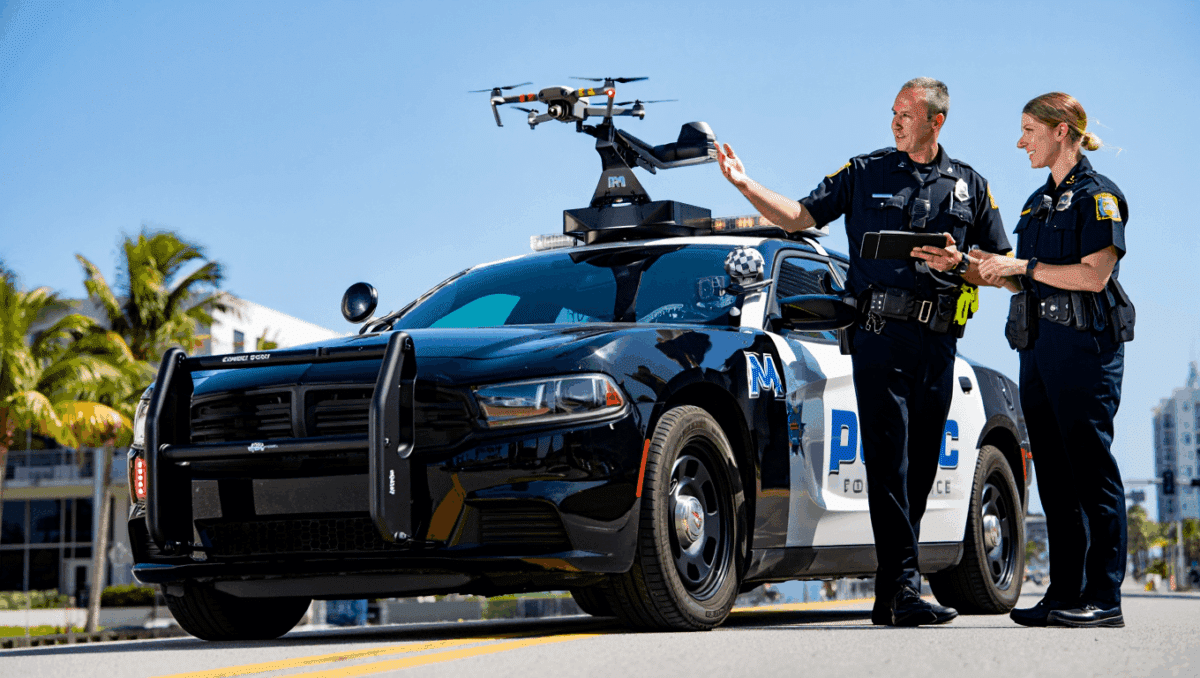
Miami is testing a new kind of patrol: a self-driving police cruiser that can launch drones into the air. The idea mixes autonomous-vehicle technology with unmanned aerial systems to create a mobile surveillance platform that can respond to incidents, gather footage, and provide officers with a bird’s-eye view without sending personnel into potentially dangerous situations.
The announcement has quickly stirred debate. Supporters say the system could speed emergency response and reduce risks for officers, while civil liberties advocates warn about expanding surveillance, unclear rules of engagement, and the possibility of mission creep.
Inside the technology: How a drone-launching autonomous police car operates
The Growing Demand for Data-Driven Decision Making in Silicon Valley
He quit, ran out of money, and begged to come back — here’s how his boss reacted
The vehicle combines several advanced systems to operate without a human driver and to deploy drones on demand. Key components include:
- Autonomous driving stack: cameras, radar, and LIDAR sensors feed into machine learning models that handle navigation, lane keeping, and obstacle avoidance.
- Onboard drone bay: a storage and launch mechanism designed to rapidly deploy small quadcopters and retrieve them after missions.
- Edge compute and communication: high-bandwidth radios and edge servers process video and telemetry locally to minimize latency during live operations.
- Remote operator interface: humans can supervise missions, take control of drones, and review footage in real time from a command center.
Typical mission workflow
- Autonomous cruiser navigates to an incident or patrols a predefined route.
- When an event requires aerial observation, the vehicle launches a drone to survey the scene.
- Drone streams video back to officers and analysts; the cruiser acts as a mobile relay and charging station.
- After the mission, the drone returns to the vehicle for data offload and recharging.
Why city leaders say this could change policing
Officials pitching autonomous drone-enabled patrols emphasize several potential benefits. Faster situational awareness, reduced risk for officers in volatile situations, and flexible deployment in traffic or hard-to-reach areas are among the most commonly cited advantages.
- Faster reconnaissance: Drones can reach vantage points faster than officers on foot or in a car.
- Lower officer exposure: Giving a drone the first look at a scene could reduce the need for immediate human entry into dangerous environments.
- Cost efficiency: Proponents argue that, over time, automation could reduce labor costs and free officers for community-facing work.
- Improved evidence collection: High-resolution aerial footage can bolster investigations and provide objective accounts of incidents.
Privacy, civil liberties, and public trust concerns
Not everyone is convinced the gains outweigh the risks. Privacy advocates and community groups caution that combining mobile, autonomous platforms with aerial surveillance could significantly expand monitoring capacity without adequate oversight.
- Persistent surveillance worries: Mobile drone-launching vehicles can move through neighborhoods, potentially increasing the frequency and scope of monitoring.
- Transparency and accountability: Critics want clear rules about when drones may be deployed, how long footage is retained, and who can access it.
- Bias and mission creep: There are fears automated systems will be disproportionately used in certain communities, or that surveillance technologies intended for serious incidents will be repurposed for routine policing.
Questions advocates are asking
- What legal standards will govern aerial searches conducted by drones?
- Will warrants be required in cases where drones capture private property or sensitive activities?
- How will data security and retention be managed to prevent misuse?
Regulatory and technical obstacles to wide deployment
Deploying autonomous, drone-capable police cars isn’t just a technical challenge; it also faces layers of regulation at city, state, and federal levels. Coordination with aviation authorities, local lawmakers, and privacy watchdogs will be essential.
- Airspace rules: Drones operating over urban areas must comply with federal aviation rules and local ordinances.
- Autonomy safety standards: Self-driving systems require rigorous testing and certification to demonstrate safe behavior in complex urban traffic.
- Interagency coordination: Emergency response protocols need updating so autonomous units interact safely with manned vehicles and first responders.
Pilot programs, partnerships, and funding
Early deployments typically start as pilots run in partnership with technology vendors and academic institutions. These smaller-scale tests help work out operational kinks, establish data policies, and measure public reaction.
- City agencies often partner with private firms that supply autonomous platforms and drone technology.
- Universities and research labs may assist with independent evaluations of safety, bias, and effectiveness.
- Funding can come from municipal budgets, federal grants, or private contracts—each route shaping oversight and transparency requirements differently.
How communities are responding and what to expect next
Public feedback ranges from cautious optimism to outright opposition. Many residents welcome tools that could make neighborhoods safer, but they also demand strong protections and community input before technologies become routine.
- Community hearings and pilot reviews are likely to shape the rollout timeline and use policies.
- Independent audits and public reporting on missions and data use could become prerequisites for broader acceptance.
- Technology vendors will continue refining safety features, such as geofencing, automatic no-fly overlays, and encrypted data channels.
Key points for residents to follow
- Watch for published rules on when and where drones may be launched.
- Request transparency about footage retention and third-party access.
- Seek clarity on oversight mechanisms and the role of civilian review boards.
You might also like:
- Dog leads police to missing 3-year-old: officer’s body cam video shows hero dog guiding rescue
- Tesla robotaxi safety driver fell asleep on duty
- Hadush Kebatu exposes surveillance state flaws
- Ontario man steals bus, completes route anyway
- Waymo viral video shows human driver on golf course

William Anderson is a multimedia producer specializing in videos, podcasts, and interactive galleries. With five years of immersive content creation, he turns information into a rich audio‑visual experience. His storytelling skills draw you directly into the heart of every story, on any platform.


Man, drones and police cars? Whats next, flying donut drones chasing speeders on hoverboards? Miami, youre living in 3021 already! But hey, whos gonna fix those drones when they crash into a palm tree, huh?
I mean, self-driving cop cars with drones? Whats next, robot officers enforcing the law? This sounds like something out of a sci-fi flick. Cant decide if its cool or creepy. Gotta keep an eye on this tech.
Imagine cruisin down Ocean Drive and spotting one of these bad boys rollin up – a drone-launching police car! Miamis takin it to the next level, man. Wonder how this plays out in the real streets, though…
Man, drones on patrol cars? Next theyll be handing out speeding tickets from the sky! Cant decide if its futuristic or downright creepy. Whats next, RoboCop 2.0? The future is wild, folks.
Oh man, drones on patrol cars? Whats next, flying tickets?! Haha, I hear you! Its like were living in a sci-fi movie, right? Cant decide if its cool or just plain eerie. But hey, imagine RoboCop 2.0 rolling up next! The future truly is a wild ride, isnt it?
Man, imagine the look on a criminals face when they see a self-driving car roll up with a drone ready to launch! Its like something out of a sci-fi flick. Cant decide if its cool or creepy. Whats next, robocops?
A conspiracy nut: What if those self-driving cop cars are just a cover-up for secret alien tech experiments? Next thing you know, those drones will be abducting us all! Keep an eye on the sky, sheeple!
Whoa, hold up! Are we in a sci-fi movie now? Drones launching from police cars? Whats next, robots handing out speeding tickets? I can already see the future chases with flying cars and laser beams.
Man, imagine drones patrolling the streets! Its like a sci-fi movie coming to life. But hey, what about peoples privacy? Are we gonna feel safer or spied on? This techs a double-edged sword, aint it?
Man, drones on patrol? Whats next, RoboCop cruising the streets? Hope they got a good firewall ‘gainst hackers. Privacy? Forget about it! But hey, it’s like a sci-fi movie come to life. The future is now, folks!
Whoa, hold up! Self-driving police cars launching drones? Are we in a sci-fi flick or what? Next thing you know, RoboCop will be patrolling the streets. Hope they dont glitch out like my old laptop, though!
Man, imagine drones busting out of a cop car! Feels like a sci-fi flick. But for real, privacy concerns aint a joke. Hope they got a tight grip on that. Trust is a fragile thing, you know?
Damn, thats some Black Mirror vibe right there! Can you picture drones popping out like Surprise, were here!? Its like the future knocking at your door uninvited. Privacys like a soap bar in a public restroom… slippery and hard to keep a grip on. Trust? Yeah, its like trying to catch smoke with your hands. Hope theyre not playing Jenga with our personal info.
I once saw a sci-fi movie where drones patrolled the streets, thought it was just movie magic. Now Miamis got self-driving cop cars launching drones? Whats next, RoboCop cruising around? This is some next-level stuff!
A conspiracy nut: So, now they got drone-launching, self-driving cop cars? Whats next, robot judges sentencin folks? Better watch out, soon well be livin in a sci-fi dystopia for real. Stay woke, people!