
Show summary Hide summary
- What the Vermont footage reveals about moths and moose
- Why moths drink tears: salt, nutrients, and survival
- Which moths might be involved and what we still don’t know
- How scientists interpret animal tolerance and possible effects on moose
- Why trail-cams and citizen science matter for new discoveries
- Broader context: salt-seeking insects and their ecological roles
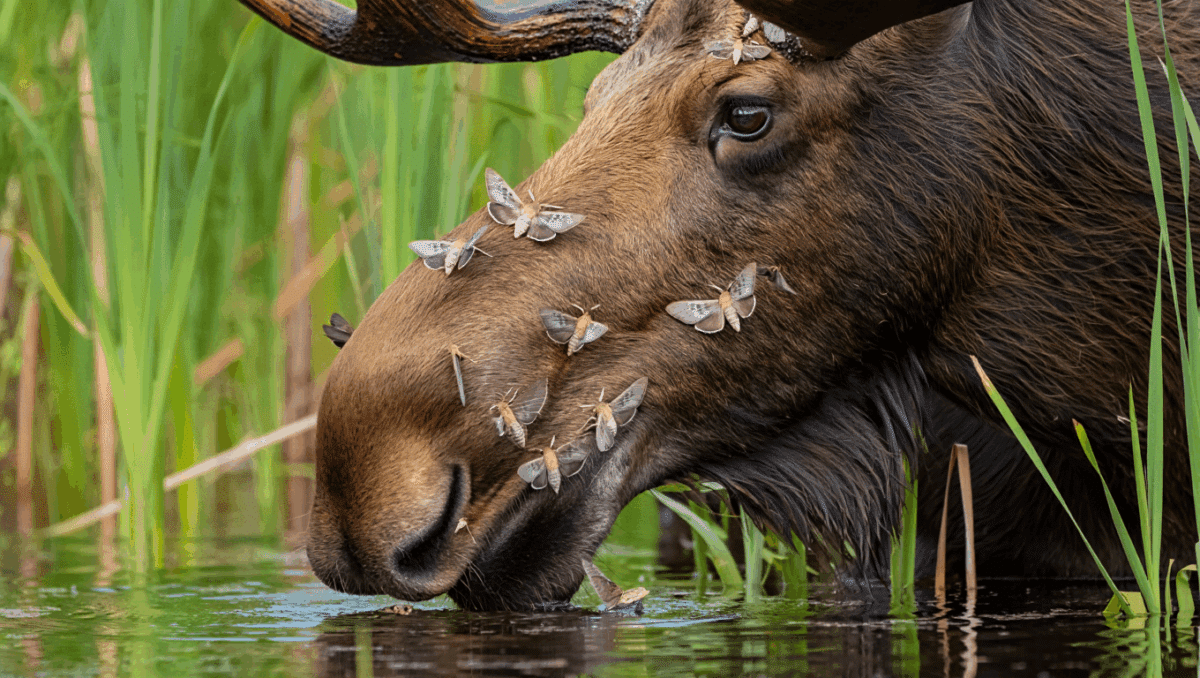
A surprising scene unfolded in a quiet Vermont wetland: moths alighting at the edge of a moose’s eye and drinking its tears. Trail-cam footage shared with local wildlife observers shows a cluster of nocturnal moths hovering close to a massive ungulate, a rare moment that reveals a hidden connection between insects and large mammals.
The images and video are more than an oddity; they capture a behavior scientists call lachryphagy — the act of drinking animal tears — which has been recorded in tropical moths and butterflies but is far less documented in North America. The Vermont footage gives researchers and nature enthusiasts a fresh look at how small, salt-seeking insects interact with megafauna in temperate forests.
What the Vermont footage reveals about moths and moose
The trail-camera clips show several moths approaching a moose resting near a marsh, landing at the wet corners of the animal’s eyes, and delicately touching the surface with their proboscises. The moose appears largely undisturbed, blinking slowly as the moths feed. The behavior repeats over multiple nights at the same site, suggesting the moose tolerated — or at least did not actively repel — the visitors.
The Growing Demand for Data-Driven Decision Making in Silicon Valley
He quit, ran out of money, and begged to come back — here’s how his boss reacted
- Clear evidence of tear-feeding: Close-up frames show moths with outstretched proboscises making contact with the tear film along the eyelid.
- Repeated visits: The same patch of marsh attracted moths to the same moose on different nights, implying a reliable source of salts.
- Low disturbance: The moose’s calm reactions indicate this is not a painful interaction, though the animal may experience minor irritation.
Why moths drink tears: salt, nutrients, and survival
Insects cannot always obtain enough sodium and trace minerals from plant nectar alone. Many species have evolved unusual foraging strategies to get these scarce nutrients. Drinking tears, sweat, blood, or even animal urine and feces provides concentrated salts and proteins that support reproduction, flight muscle function, and neural activity.
How lachryphagy helps moths
- Salt supplementation: Tears supply sodium and chloride ions that are rare in floral nectar.
- Protein intake: Tear fluid contains proteins and amino acids useful for egg production.
- Reproductive boost: Access to salts can increase a female’s fecundity and a male’s mating success.
Lachryphagy is a documented survival strategy among several Lepidoptera groups worldwide. Tropical researchers have observed butterflies and moths sipping tears from turtles, crocodiles, and even sleeping mammals. The Vermont sightings suggest the behavior is more geographically widespread than previously thought.
Which moths might be involved and what we still don’t know
The footage shows medium-to-large nocturnal moths, but identification from trail-cam video alone is challenging. North America hosts many families — such as Noctuidae and Erebidae — whose members are active at night and are capable of seeking alternative salt sources.
Key unknowns include:
- Exact species identity: High-resolution photos or netted specimens would help confirm which moths are involved.
- Frequency: How common is lachryphagy in Vermont’s moth populations?
- Ecological drivers: Are roadside salt runoff, mineral-poor diets, or seasonal needs increasing tear-feeding behavior?
Researchers urge anyone who spots similar interactions to document them with date-stamped photos or videos and to share details with local naturalist groups or university entomology departments.
How scientists interpret animal tolerance and possible effects on moose
From the moose’s perspective, the cost of tear-feeding might be minimal. Mammals produce tears to keep eyes moist and to flush irritants. A few gentle visitors may cause brief discomfort but rarely lead to long-term harm. However, there are potential risks if tear-feeders transmit pathogens or provoke repeated irritation.
Potential animal health concerns
- Minor irritation and increased blinking, which can disrupt feeding or resting cycles.
- Possible vector transmission if insects carry microbes between animals.
- Stress if insect numbers are high or if feeding concentrates on vulnerable individuals (calves, sick animals).
Wildlife veterinarians note that while most documented cases show little direct harm, the cumulative effects of repeated pest pressure or secondary infections merit further study.
Why trail-cams and citizen science matter for new discoveries
Trail cameras and smartphone photography have vastly expanded our ability to record rare wildlife interactions. Unlike human observers, motion-activated cameras operate continuously at night and in remote places, capturing behaviors that might otherwise go unnoticed. This Vermont example underscores how non-invasive monitoring can reveal previously undocumented ecological links.
How to contribute useful data:
- Use time-stamped images or video and record location coordinates.
- Note environmental context: wetland, roadside, salt-treated areas, or animal behavior before/after the interaction.
- Share with local wildlife groups, universities, or national databases for verification.
Documenting odd behaviors strengthens scientific knowledge by providing the raw observations researchers need to form hypotheses and plan field studies.
Broader context: salt-seeking insects and their ecological roles
Tear-drinking is one of several salt-acquisition tactics insects use. Mud-puddling butterflies gather at mineral-rich soil; bees and flies visit dung or urine; some moths have been seen piercing fruit or even mammal skin in other parts of the world. These behaviors show the lengths to which small animals will go to meet physiological needs.
Ecologically, these interactions:
- Create unexpected contact points between species that may influence nutrient cycles.
- Offer insights into habitat quality — frequent salt-seeking may signal nutrient-poor environments.
- Reveal adaptive behaviors that could shift with climate change and land-use patterns.
You might also like:
- Tow truck driver rescues moose, tells stranded customers to wait
- Colorado wildlife overpass, North America’s largest, opens to help animals cross highways safely
- Wildlife overpass cuts I-25 animal collisions by 91%
- Snow leopard attack during selfie leaves woman badly injured
- Pigeon rescued by firefighters after walking up for oxygen to clear its lungs

William Anderson is a multimedia producer specializing in videos, podcasts, and interactive galleries. With five years of immersive content creation, he turns information into a rich audio‑visual experience. His storytelling skills draw you directly into the heart of every story, on any platform.


Dude, natures wild, man. Moths sippin on moose tears? Thats some next-level stuff. I mean, who wouldve thought? Natures full of surprises, keeps us on our toes. Wonder what else those sneaky moths are up to…
Yo, can you believe those moths in Vermont? Sippin on moose tears like its happy hour. Natures wild, man. Wonder if the moose minds being the bartender for these salty little fellas.
Moose tears for moths? Natures wild, man. Imagine being a moth like, Hey bro, Im thirsty, lets hit up that moose for a drink. Natures got its own dive bar, I guess.
Oh man, these Vermont moths are wild! Who knew they were out here sippin on moose tears like its happy hour? Nature never fails to amaze, I tell ya. Wonder what other secret party tricks these critters got up their sleeves.
Oh man, I always knew moths were a bit quirky, but sippin on moose tears? Thats next-level weirdness! Can you imagine the convo between those two? Hey there, got any salty drinks to share? Wild!
Man, those moths in Vermont are wild! Drinking moose tears? Thats some next-level stuff. Can you imagine being a moth and thinking, Hmm, I could go for a salty drink right now? Nature never fails to surprise.
Man, those Vermont moths are wild! Drinking moose tears like its happy hour at the swamp. Natures got some crazy combos, huh? Wonder if the moose charges extra for the salty service.
Oh man, those Vermont moths are indeed on a wild ride! Who knew they were into salty snacks? Natures throwing some unexpected parties out there. Wonder if the mooses got a tip jar for those tears? Its like a swampy happy hour scenario!
Man, talk about nature being wild! Moths sipping on moose tears like its happy hour at the local pub. Who knew insects had such refined taste buds? Guess were all just out here trying to survive in our own unique ways.
Moose tears? Moths sippin on em? Natures wild, man. Can you imagine the moth party happenin on that mooses face? Natures got some funky surprises, for real.
Bro, thats some next-level partying for moths! Can you picture the tiny disco happening on Mr. Mooses face? Natures like a surprise box, man, always throwin curveballs. Who knew tears could be the new moth hangout spot? Natures got jokes, for real!
I once saw a moth dive-bomb into my soda, but drinking moose tears? Thats next level! Natures got some wild party tricks up its sleeve. Wonder if those moths ever get emotional cravings now.
Man, natures full of surprises! Moths sippin on moose tears? Thats wild! Guess theyre into salty snacks too. Natures menu keeps gettin more unexpected. Wonder whats next on the critter cafe list!
I mean, who knew moths had a thing for moose tears? Natures full of surprises, man. Can you imagine being a moth, like, Hey, lets hit up those moose tears for a snack? Wild stuff.
Dude, for real! Natures got its own funky ways, man. I can picture those moths having a lil party at the mooses expense, like, Yo, lets raid those tear drops! Natures like a whole mystery box, you never know what youre gonna get next. Wild ride, huh?
Yo, can you believe these Vermont moths sippin on moose tears? Natures wild, man. Next thing you know, well catch squirrels doing backflips for acorns. Mother Earth never fails to amaze.
Man, these moths in Vermont living their best life sippin on moose tears, gotta respect the hustle. Natures wild, right? Wonder if they ever throw moth parties after a good tear feast. Natures got the best drama!