
Show summary Hide summary
- How the team digitally removed death masks: medical scans meet 3D modeling
- What the unveiled faces reveal about past lives and health
- Why death masks were applied and how they complicate study
- Ethical questions and community engagement surrounding digital restoration
- Digital archaeology’s next steps: research, outreach, and preservation
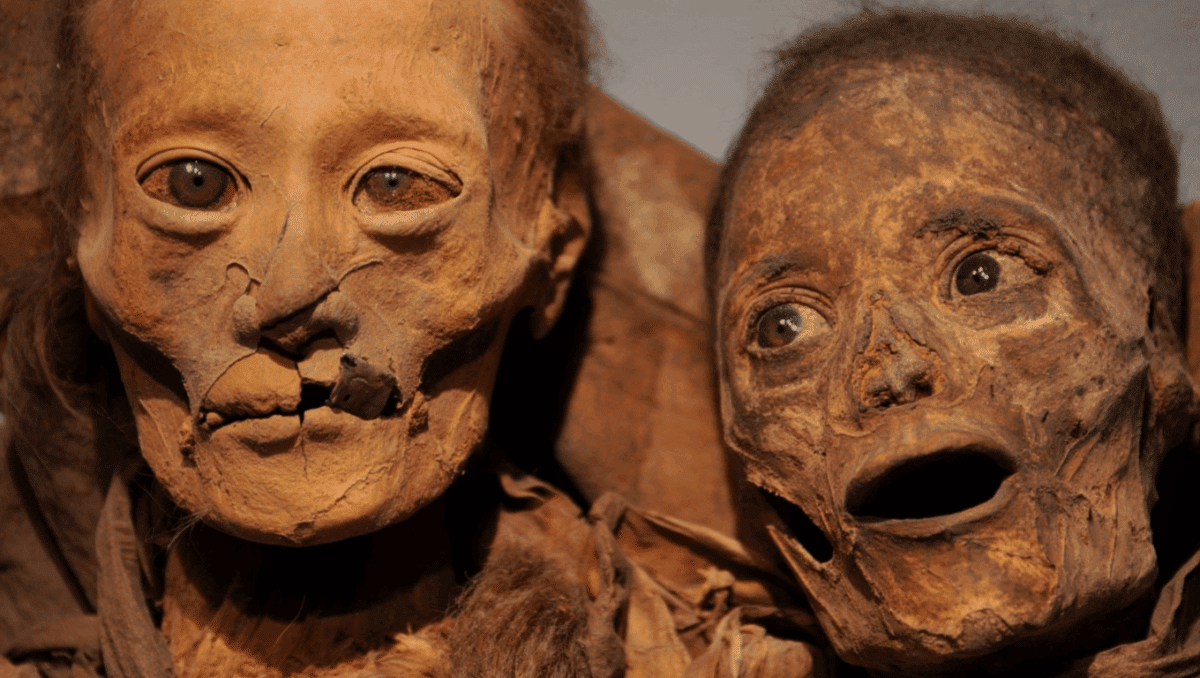
Scientists in Colombia have used advanced imaging and 3D modeling to digitally peel away historic funeral masks and expose the faces beneath, offering a rare, intimate glimpse into lives from the region’s past. The process, noninvasive and reversible, is changing how researchers study mummified remains while raising fresh questions about cultural stewardship and museum practice.
What began as a technical exercise to document fragile remains became a striking visual revelation: beneath layers added long after burial, these faces—once hidden—reappear with surprising clarity. The work marries medical imaging, digital restoration, and archaeological context to deliver new evidence about health, identity, and the complex afterlives of human remains in museum collections.
How the team digitally removed death masks: medical scans meet 3D modeling
Researchers relied on a blend of imaging technologies and computational tools to separate original human tissues from later additions without touching the artifacts. The approach preserves physical integrity while producing high-resolution digital replicas that can be examined, shared, and archived.
The Growing Demand for Data-Driven Decision Making in Silicon Valley
He quit, ran out of money, and begged to come back — here’s how his boss reacted
Step-by-step: the noninvasive workflow
- High-resolution CT scanning: Whole-body and localized CT scans capture internal anatomy and the layered structure of masks, wrappings, and bone.
- Digital segmentation: Software isolates different materials—bone, skin, textiles, plaster—by density and texture so specialists can label each layer.
- Virtual removal and reconstruction: Mask material is rendered invisible in the 3D model while algorithms reconstruct facial features where needed.
- Validation and visualization: Cross-checks with x-rays, conservation records, and comparative anatomy ensure reconstructions are plausible; results are prepared for interactive displays and scientific analysis.
The advantage of this pipeline is twofold: it avoids destructive sampling and preserves a digital record that can be reanalyzed as methods improve. That makes the technique especially valuable for fragile collections or remains held in distant museums.
What the unveiled faces reveal about past lives and health
When death masks—some of which were applied or modified by collectors and curators—are removed digitally, what emerges is more than a visual curiosity. The faces can provide clues about age, nutrition, disease, trauma, and cultural practices that affected the individuals long before they were curated.
- Health indicators: Dental wear, healed fractures, and sinus pathology are visible in CT-derived models and help build profiles of childhood conditions and adult lifestyles.
- Demographic insights: Skull shape and facial morphology support assessments of age and biological sex when combined with other osteological data.
- Cultural practices: Evidence of cranial modification, dental modification, or ceremonial adornment can contextualize social identity and status.
Researchers emphasize caution: facial reconstructions are interpretive and most accurate when combined with genetic, isotopic, and archaeological evidence. Still, the digital faces add a humanizing dimension to skeletal data, reminding viewers that museum specimens were once people with stories and communities.
Why death masks were applied and how they complicate study
Death masks—whether created at burial, added later for display, or formed accidentally during preservation—have served many roles. They have memorialized the dead, been used in anthropological study, or been applied by collectors to meet aesthetic expectations for display.
Common reasons masks appear on mummies
- Funerary rites intended to present an idealized visage for the afterlife.
- Museum practices from earlier centuries that altered remains to conform to display norms.
- Conservation attempts that unintentionally obscured original anatomy.
Because masks can distort or hide anatomical markers, their presence complicates research. Digital removal lets scientists see beneath those later interventions without risking the original materials, restoring access to biological and cultural data previously blocked by conservation history.
Ethical questions and community engagement surrounding digital restoration
Digital unveiling of faces touches on sensitive ethical terrain. Descendant communities, curators, and scientists may hold differing views on whether remains should be displayed or analyzed at all. For that reason, teams using these techniques increasingly emphasize consultation and shared decision-making.
- Community consultation: Involving descendant groups in decisions about scanning, display, or publication acknowledges cultural values and can guide respectful interpretation.
- Repatriation and access: Digital surrogates can support repatriation claims or provide communities with high-fidelity, nonremovable records when physical returns are complex.
- Transparency: Publishing methods, datasets, and ethical frameworks helps build trust and allows peer review of reconstruction choices.
Noninvasive digital methods do not remove these ethical questions; they complicate them in new ways by making images widely distributable. As a result, protocols for consent, data sharing, and curation are becoming central to responsible practice.
Digital archaeology’s next steps: research, outreach, and preservation
As technology matures, the same digital workflows can support wider aims: virtual exhibits that let the public explore objects that cannot be displayed, collaborative databases for comparative study, and tools to simulate different conservation scenarios without ever touching the artifact.
Opportunities for museums and researchers
- Create immersive educational content that respects privacy and cultural protocols.
- Build open archives of scan data that permit re-analysis and methodological improvements.
- Develop interdisciplinary projects that pair imaging with genetics, isotopes, and historical records for richer narratives.
These advances are shifting how institutions balance research imperatives with respect for cultural heritage. When handled thoughtfully, digital removal of death masks can enrich scholarship and public understanding while keeping the physical remains safe and communities involved.
You might also like:
- Ancient snake found in London museum: what we know
- 28,000-year-old burial reveals teenager suffered brutal bear attack
- Tower of London skeletons: more than 20 found, some likely plague victims
- Sperm cells turned into trackable microbots by scientists
- Archimedes manuscript lost page found in museum reveals hidden text under illustration

William Anderson is a multimedia producer specializing in videos, podcasts, and interactive galleries. With five years of immersive content creation, he turns information into a rich audio‑visual experience. His storytelling skills draw you directly into the heart of every story, on any platform.


Man, those Colombian mummies unveiling is like uncovering ancient selfies. Its wild how technology can bring history to life. Wonder if theyd approve of their post-mortem glow-up. #MummyMakeover
Man, those Colombian mummies getting a digital makeover! Wonder if theyd be down for a glow-up challenge on TikTok next. Bet their skincare routine is killer! #MummyMakeover #AncientGlowUp
Man, uncoverin them Colombian mummies faces? Thats some next-level CSI stuff! Can you imagine the stories those faces could tell if they could talk? Bet theyve seen some wild things back in the day.
Man, those Colombian mummies are giving me chills! Crazy how they digitally removed those death masks. Imagine peeking into the past like that. Wonder what stories those faces could tell…
Man, seeing those Colombian mummies faces unveiled is like peeking into historys diary. Wonder what stories those expressions hold. Ancient mysteries getting a modern makeover!
Whoa, uncovering those Colombian mummies faces by peeling off their death masks? Thats some eerie CSI stuff right there! Can you imagine the stories those faces could tell if they could talk? Spooky but fascinating, man.
Whoa, bro, those Colombian mummies getting their death masks peeled off is some next-level spooky stuff, right? Imagine if those faces could actually spill some ancient tea – thatd be a wild Netflix series right there! Its like a real-life ghost story mixed with a history lesson. Crazy, man!
Mate, these mummies unveiling got me thinking – imagine if they started walking around like zombies! Whod be ready for that twist in the archaeological plot, eh? Bet theyd have some stories to tell… or moan about.
Man, these Colombian mummies with their death masks removed got me feeling like Im in an ancient episode of CSI. Who needs TV drama when history serves up real-life mysteries like this? Mind officially blown!
Man, these mummies got a makeover! Revealing faces under masks? Creepy cool. Bet theyve got stories to tell… if only they could speak. Wonder what secrets those ancient eyes hold.
Wait, they digitally stripped off mummy faces? Thats wild! Can you imagine snooping on ancient folks like that? Bet theyd have some stories to tell. Wonder what secrets those faces hold…
Haha, man, thats some creepy stuff! Imagine scrolling through your Insta and stumbling upon your great-great-great-grandmas face without her permission! Its like theyre unearthing the OG influencers of ancient times. Wonder if theyd have a TikTok account or something. #TimelessTikToks
I couldnt believe it when I saw these mummies real faces! Its like a peek into history, man. Wonder what stories those faces could tell if they could talk. Crazy stuff, for sure.
Man, those mummies faces are wild, right? Like, imagine if they started chatting. I bet theyd spill some juicy ancient gossip. Oh, Cleo, did you hear about Ramses latest pyramid party? History would never be the same, dude. Crazy to think about!
Man, these mummies got a glow-up! Removing those death masks is like uncovering ancient selfies. Wonder what secrets those faces hold… Time for a history deep-dive!
Dang, these mummies really be stepping up their game! Unmasking those sarcophagus selfies is like digging up some juicy gossip from the past. Im so ready to dive deep into that ancient tea. Who knows what drama went down back then, right? Lets crack the case!
Man, seeing those Colombian mummies faces revealed is like peeking into a time machine! Imagine the stories those faces could tell. Makes you wanna dig deeper into history, huh? Wonder what secrets theyre hiding.