
Show summary Hide summary
- What the researchers found: a previously unknown extremophile in plain sight
- How the species survives in hypersaline conditions
- Why this discovery matters for ecology and conservation
- How researchers documented and verified the find
- Implications for wildlife, industry, and local communities
- Questions researchers want to answer next
- Broader scientific and educational value
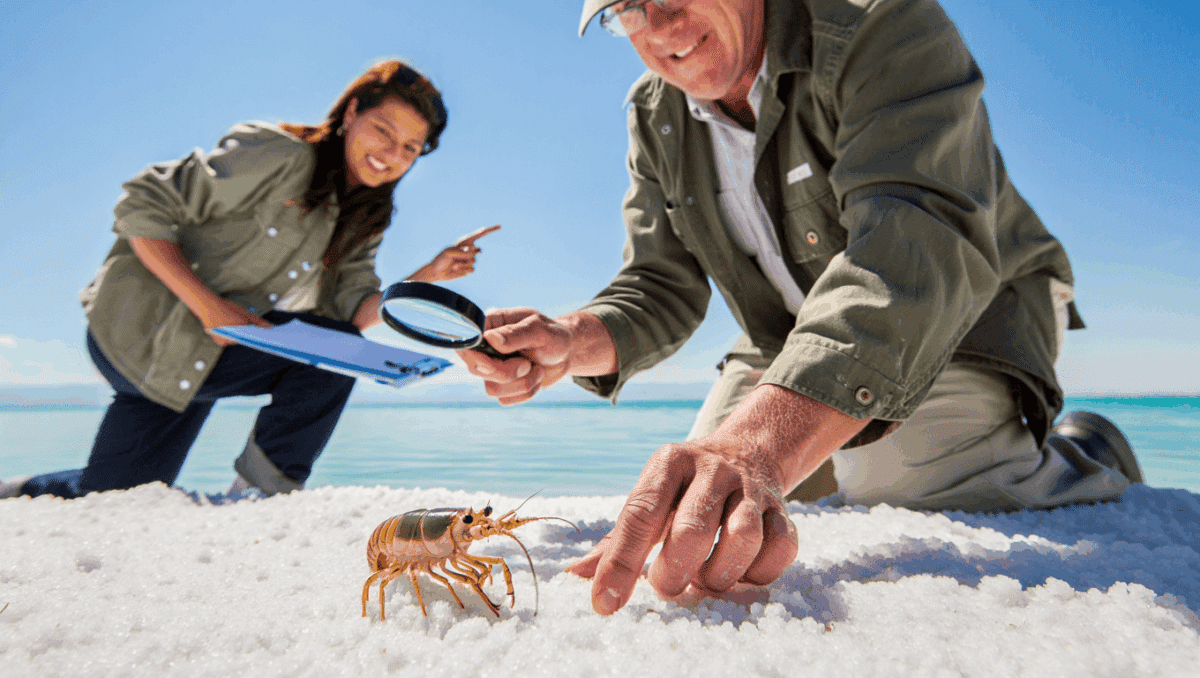
Scientists exploring the shifting shores of the Great Salt Lake have identified a creature unlike any previously cataloged in North America’s largest saltwater expanse. The discovery, announced recently, is stirring excitement among ecologists and conservationists because it challenges assumptions about who can thrive in such harsh, salty conditions — and it raises fresh questions about the lake’s fragile future.
This newly described organism appears to be a specialized survivor of extreme salinity, adapted to an environment many species find inhospitable. Researchers say its presence sheds light on the complex and underappreciated biodiversity of the Great Salt Lake, and may offer clues about evolutionary resilience and the impacts of human-driven environmental change.
What the researchers found: a previously unknown extremophile in plain sight
Researchers conducting routine sampling of plankton and sediment along shallow bays came across an organism that did not match known descriptions for brine shrimp, brine flies, or the common microbial mats. Under the microscope, it displayed a combination of physical traits that set it apart from familiar salt-lake inhabitants.
The Growing Demand for Data-Driven Decision Making in Silicon Valley
He quit, ran out of money, and begged to come back — here’s how his boss reacted
- The body plan suggested a small crustacean-like animal with unusual setae (bristles) and segment articulation.
- Genetic sequencing showed clear divergence from known lineages, pointing to a previously undescribed species or possibly a new branch within an obscure group of extremophiles.
- Its distribution was patchy but persistent across multiple sampling locations, indicating it is an established resident rather than a transient invader.
Initial DNA analysis confirms distinct genetic markers. Samples sent for molecular work revealed markers that do not align with database records for documented Great Salt Lake fauna. That genetic uniqueness is what convinced researchers to pursue a formal species description.
How the species survives in hypersaline conditions
Life in the Great Salt Lake requires special adaptations. Salinity in some parts of the lake exceeds that of the ocean by several times, creating a chemical environment that dehydrates most animals and interferes with basic cellular processes. This new organism displays several likely strategies for survival:
- Osmoregulation mechanisms that help retain water and control ion exchange.
- Structural features — such as dense outer cuticle layers — that reduce water loss.
- Behavioral habits, including occupying microhabitats (brackish pockets, sediment boundaries) where salinity fluctuates less dramatically.
Microhabitats and seasonal refuges
Samples suggest the species favors shallow, protected bays and areas where freshwater inflows dilute salinity seasonally. During dry spells or abrupt salinity spikes, it may retreat into sediment or use dormant life stages, strategies seen in other salt-adapted species. These life-history traits help explain why it remained undetected by casual observation for so long.
Why this discovery matters for ecology and conservation
The finding is more than an academic curiosity. It offers practical insights into the Great Salt Lake’s ecological web and how that web may respond to ongoing stressors such as lower water levels, higher salinity, and habitat fragmentation.
- Indicator of ecosystem health: The presence and population trends of specialist species can signal changing environmental conditions sooner than broader surveys.
- Food web linkages: If this species is prey for birds or other invertebrates, its decline or growth could ripple through local food chains.
- Biodiversity value: Each newly described species increases the known biological richness of the lake, strengthening arguments for conservation action.
Scientists caution that the discovery also highlights how much remains unknown. The Great Salt Lake has experienced dramatic water loss in recent decades due to prolonged drought and water diversions, threatening habitats that may house additional undiscovered life forms.
How researchers documented and verified the find
The team used a multi-step approach combining field sampling, morphological study, and genetic testing to make a strong case for a new species designation.
- Systematic sampling across seasons and sites to confirm distribution.
- High-resolution microscopy to document anatomy and compare traits with known taxa.
- DNA barcoding and genomic sequencing to test genetic distinctiveness.
- Peer consultation with taxonomists to avoid misclassification and ensure rigorous description.
Rigorous peer review and open data sharing are planned next, with researchers preparing a formal species description for publication in a scientific journal. They’ve also deposited genetic sequences in public databases so other scientists can validate and build on their work.
Implications for wildlife, industry, and local communities
The Great Salt Lake supports important migratory bird populations, commercial brine shrimp harvests, and recreational uses. A change in the lake’s biological composition could have cascading implications.
- Birds that rely on brine shrimp and fly larvae as food might be affected if community structure shifts.
- Commercial harvesting operations monitor species composition closely; unknown species raise questions about potential impacts on yields and sustainability.
- Local communities and Indigenous groups with cultural ties to the lake may find new ecological dynamics altering long-standing relationships with the landscape.
Conservation groups argue that discoveries like this bolster the case for protecting remaining wetlands and restoring water flows to the lake. Researchers echo that by noting how fragile specialist species can be when habitats degrade.
Questions researchers want to answer next
The initial discovery opens many research avenues. Priority questions include:
- What is the full geographic range of the species within the Great Salt Lake and nearby saline systems?
- How does it interact with other organisms — is it prey, predator, or competitor?
- What are its reproductive cycles and population dynamics across seasons and salinity gradients?
- Can its physiological adaptations inform broader studies of extremophiles and biotechnology?
Field campaigns are being planned to map populations more thoroughly, while laboratory experiments will probe tolerance limits and life-cycle strategies. Researchers also hope to engage citizen scientists and local volunteers in monitoring efforts, expanding the observational footprint at a low cost.
Broader scientific and educational value
Beyond immediate conservation concerns, the discovery enriches our understanding of evolution under extreme environmental pressure. It serves as a vivid, local example that could be used in classrooms and outreach programs to highlight biodiversity, adaptation, and the consequences of human impacts on inland saline ecosystems.
Finding a new species in a well-studied area like the Great Salt Lake underscores how much of nature’s story is still unwritten. It also provides a compelling narrative to encourage policy makers and the public to take notice of the lake’s environmental health and support measures that protect its unique life.
You might also like:
- Thousands of flamingo chicks hatch in Turkey in major comeback after climate disaster
- Dolphin health revealed by seawater eDNA sampling in a conservation first
- Deep-sea survey finds 24 new species, including new family of amphipods
- Neon orange shark found in Costa Rica: what scientists know
- White abalone found alive after 5 years in Channel Islands survey sparks hope for recovery

William Anderson is a multimedia producer specializing in videos, podcasts, and interactive galleries. With five years of immersive content creation, he turns information into a rich audio‑visual experience. His storytelling skills draw you directly into the heart of every story, on any platform.


Yo, check this out! A new species chilling in the Great Salt Lake, doin its extremophile thing. Natures mad fascinating, man. Imagine kickin it in hypersaline waters like it aint no thang. Wild!
Yo, thats some next-level stuff right there! Chillin in hypersaline waters like a boss, huh? Nature never fails to surprise, man. Makes you wonder what else is out there, just doing its thing under the radar. Pretty wild, aint it?
Man, talk about natures surprises! This new extremophile in the Great Salt Lake is like finding a hidden gem in your backyard. Makes you wonder what other secrets are lurking in plain sight, huh? Natures full of tricks up its sleeve!
Man, talk about a plot twist in the science world! Just when you think youve seen it all, boom, new species in the Great Salt Lake! Nature never fails to surprise us, right? Cant wait to see what other secrets are hiding out there.
Yo, can you believe they found a new species in the Great Salt Lake? Its like a hidden world out there. Natures always throwing curveballs, man. Wonder what other surprises are lurking in plain sight!
I always knew the Great Salt Lake was hiding some secrets, but a new extremophile? Thats wild! Nature never ceases to surprise. Cant wait to see what other hidden gems are lurking in plain sight out there.
Man, talk about a plot twist! Finding a new species right under our noses in the Great Salt Lake? Natures full of surprises, aint it? Cant wait to see what other secrets its hiding.
Man, talk about nature flexing its muscles! Finding a new species in the Great Salt Lake is like stumbling upon a hidden gem in a thrift store. Cant wait to see what other surprises Mother Earths got up her sleeve!
Man, this makes me feel like I missed my calling in marine biology. Just when you thought you knew all the cool creatures out there, BAM, science drops a new extremophile on us. Natures always throwing surprises, aint it?
I mean, discovering a new species in the Great Salt Lake is like finding a hidden treasure in your backyard! Its wild how nature keeps surprising us. Cant wait to see what other secrets this place holds.
Dang, talk about hidden gems in plain sight! Its like finding a secret level in a video game youve been playing for years. Nature, you sneaky genius! Cant wait to see what other surprises shes got up her sleeve.
Man, talk bout a plot twist in natures soap opera! Just when ya think ya know all bout the cast, boom, a new character arrives! Cant wait to see how this extremophile steals the scene in the hypersaline drama.
Man, the Great Salt Lake be poppin with new discoveries! This extremophile is like the ninja of the lake, survivin in hypersaline conditions. Natures full of surprises, aint it? Time to update the lakes yearbook!
So, lemme get this straight – weve been living alongside a whole new species chillin in the Great Salt Lake? Talk about neighbors from another planet. Wonder what other surprises Mother Natures hiding in plain sight.
Man, this discoverys like stumbling upon a secret level in a video game. The fact that theres a whole new species chilling in the Great Salt Lake blows my mind. Cant wait to see what other surprises Mother Natures hiding.
I heard about this new extremophile chillin in the Great Salt Lake – talk about adaptability goals! Wonder what other surprises Mother Natures hiding in her pockets. Cant wait for more mind-blowing discoveries!
Man, this discoverys like finding a hidden level in a video game! The Great Salt Lakes secrets run deep, huh? Bet those extremophiles throw wild parties in their hypersaline pad. Wonder what else is lurking out there!