
Show summary Hide summary
- How spiders craft convincing body doubles
- Species that use “fake self” tactics
- Why mimicry by construction works against predators
- What experiments reveal about decoy effectiveness
- How predators adapt and the ongoing evolutionary arms race
- Beyond survival: additional benefits of built decoys
- Visual cues, materials and the role of the environment
- Insights for science and human design
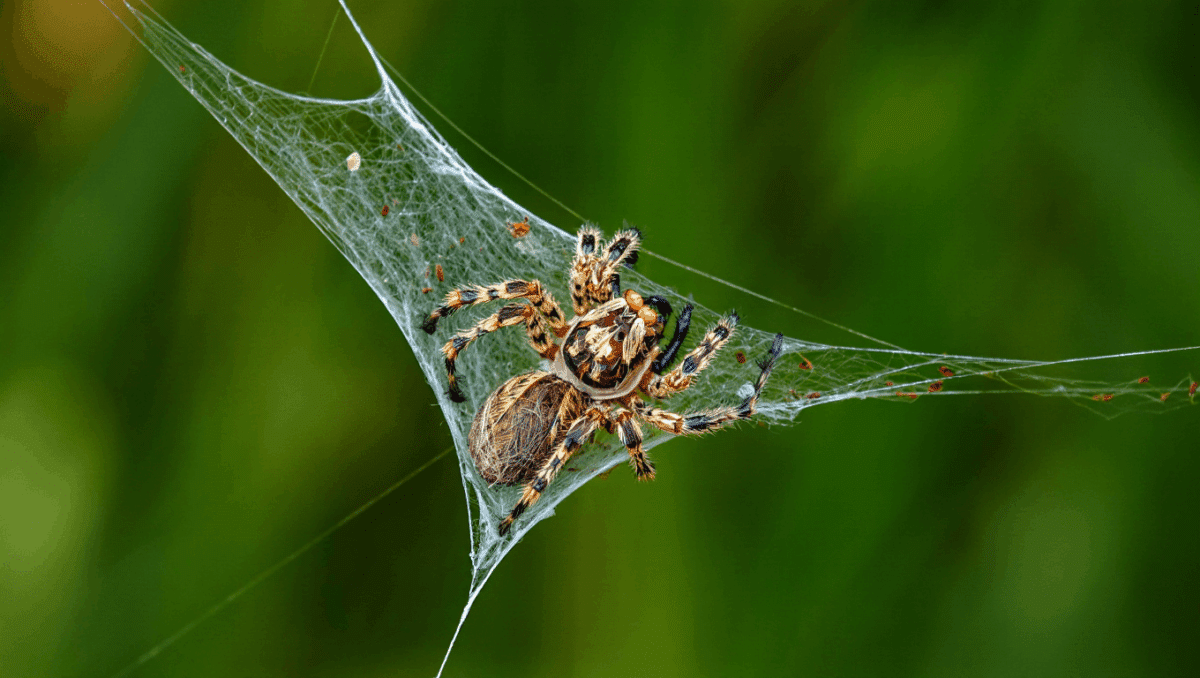
Spiders are quietly engineering illusions. In some species, what looks like a lone spider at the center of a web is actually a carefully arranged scene: silk, prey remains, plant bits and egg sacs that together form a convincing lookalike. These fabrications can divert the attention of hungry predators and give their creators a better chance of survival.
Researchers who study arachnids are increasingly fascinated by these ghostly doubles. Across tropical forests, backyards and even urban green spaces, spiders are using materials at hand to build decoys that blur the line between biology and bricolage. Below, we break down how they do it, which species are known for the trick, and what experiments reveal about the arms race between web architects and their hunters.
How spiders craft convincing body doubles
Many orb-weaving and trash-line spiders assemble visual distractions by combining silk with bits of debris. The goal is less about decoration and more about deception: presenting a false target or hiding the real body. The techniques vary by species, but common elements include:
The Growing Demand for Data-Driven Decision Making in Silicon Valley
He quit, ran out of money, and begged to come back — here’s how his boss reacted
- Aligning silk bands and debris so the decoy mirrors the spider’s posture.
- Using prey remains, egg sacs and plant fragments as building blocks.
- Positioning the fake slightly offset from the spider’s true location to confuse attackers.
- Changing the arrangement over time to match the spider’s orientation or life stage.
These constructions are not accidental. They are deliberate, repeatable behaviors that increase the spider’s chances of escaping predation by visually driven hunters such as wasps and birds.
Species that use “fake self” tactics
Arachnologists have documented a range of species that use decoys, from tropical orb weavers to temperate trash-line spiders. Notable examples include:
- Cyclosa ginnaga — This orb weaver arranges silk and prey remains along its web’s vertical axis in a way that mirrors its body, often forming a clear double.
- Cyclosa turbinata — Known for a conspicuous “trashline” of wrapped prey and detritus that can misdirect predators.
- Other Cyclosa species — Several relatives use similar strategies, with local variations in material and pattern.
- Some orb-weavers (e.g., Argiope spp.) — While best known for stabilimenta (zigzag silk bands), these structures sometimes function as visual cues that may alter predator behavior.
Each species adapts the general idea of a decoy to its habitat and the visual systems of its main predators.
Why mimicry by construction works against predators
Predators that hunt by sight—parasitic wasps, birds and some mammals—rely on simple cues to locate prey in complex environments. A spider’s silk and trashline can break up its outline or create an alternate focal point, making it harder for predators to strike accurately.
Key reasons this strategy is effective:
- Visual confusion: The brain of a predator may lock onto the most conspicuous object in the scene, which could be the decoy rather than the spider.
- Target dilution: Multiple similar-looking objects reduce the probability that a predator will select the real spider.
- Momentary delay: Even a brief hesitation by a predator can allow the spider to flee or reposition, improving survival odds.
In ecological terms, these fake selves function as anti-predator adaptations. They alter the information available to predators rather than physically preventing attacks.
What experiments reveal about decoy effectiveness
Field and lab studies have tested how well spider decoys work. Researchers manipulate webs, remove or add trashlines, and observe predator reactions. Findings generally show:
- Decoys reduce successful attacks by visually hunting predators in many contexts.
- Effectiveness depends on the predator’s search strategy—some hunters are easily fooled, others less so.
- Behavioral flexibility in spiders (adjusting decoy size or position) can improve outcomes when predator pressure changes.
One repeated finding is that predators often strike at the most obvious object in the scene, even when it is non-living. This visual bias is what spiders exploit.
How predators adapt and the ongoing evolutionary arms race
No adaptation exists in isolation. Predators under strong selection pressure can evolve or learn counterstrategies:
- Learning: Birds and wasps can learn to ignore non-food items or to probe multiple objects before attacking.
- Refined search patterns: Predators may shift to tactile or olfactory cues in addition to vision.
- Temporal targeting: Some hunters attack at times or from angles that reduce the effectiveness of decoys.
This back-and-forth drives continuous refinement in both spider construction behaviors and predator foraging techniques. In some ecosystems, the interaction looks like a game of perceptual cat-and-mouse.
Beyond survival: additional benefits of built decoys
While predator deception is the headline, decoy structures can provide secondary advantages:
- Camouflage for egg sacs — integrating egg cases into the trashline may protect offspring.
- Prey capture effects — certain decorations can influence insect approach patterns, sometimes increasing capture rates.
- Structural reinforcement — added silk and debris can stabilize fragile webs in windy conditions.
The multifunctional nature of these constructions makes them particularly valuable in variable environments.
Visual cues, materials and the role of the environment
The choice of debris and the arrangement of silk reflect local conditions. Spiders in leaf-littered forests use different materials than those in sparse grasslands or urban gardens. Lighting, background complexity and predator community composition all shape what works best.
Factors that matter:
- Contrast with background — bright or dark materials can either highlight or mask the decoy.
- Availability of building materials — what’s on hand determines the look and texture of the fake.
- Microhabitat stability — in windy or rainy sites, spiders may favor more robust constructions.
Researchers often find geographic variation in decoy style, reflecting adaptive responses to local selective pressures.
Insights for science and human design
Studying spider-built decoys offers windows into perception, evolution and material use. Scientists draw inspiration from these natural strategies for applications ranging from camouflage technology to algorithms that exploit attention biases.
Areas of interest include:
- Understanding visual attention and how simple cues capture or divert focus.
- Designing low-cost, low-energy camouflage that manipulates observer perception.
- Learning how modular, repairable constructions perform in changing environments.
These biological lessons may inform both conservation efforts and engineering problems where misdirection or low-visibility solutions are useful.
You might also like:
- 30 centimeters wide and 170 grams: meet the world’s largest spider, eaten by locals
- Pearl necklace spider discovered: what scientists know about the new species
- Heartbreak High actor Bryn Chapman Parish: can men really change?
- Coyote statues guard local school playgrounds and deter pests
- Megaraptor fossil found with ancient crocodile in its mouth

William Anderson is a multimedia producer specializing in videos, podcasts, and interactive galleries. With five years of immersive content creation, he turns information into a rich audio‑visual experience. His storytelling skills draw you directly into the heart of every story, on any platform.


Man, spiders are on another level with these fake bodies! Its like theyre running some espionage operation in the insect world. Can you imagine if we humans could craft decoys like that? Wed be unstoppable!
Man, spiders be out there playing 4D chess with their fake bodies! Crafty little critters. Cant blame em for trying to outsmart their predators. Natures a wild game of survival, huh?
I once saw a spider weaving a mini-me version of itself—talk about next-level deception tactics! Natures got spies in the form of eight-legged tricksters. Cant trust anyone, not even the critters in your own backyard!
Man, spiders out here playing 4D chess with their decoys. Can you imagine the audacity? Mother Nature really be giving them creative powers. Next thing you know, theyll be casting illusions and doing magic tricks!
I heard about those sneaky spiders! Crafty little critters, building decoys to throw off their enemies. Imagine if we could create fake versions of ourselves to confuse our problems away. Life would be a whole lot easier, huh?
Man, spiders are like the ultimate tricksters of the bug world! Crafting these decoy bodies to fool predators? Thats some next-level strategy right there. Can you imagine if we humans could do that? Like, Oh no, Mr. Lion, dont eat me, eat my fake self!
Spiders makin body doubles now? Cant trust anyone, not even creepy crawlies. Imagine tryna be all tough, then bam, your lunch is a decoy. Natures got jokes, man.
Man, spiders really out there playing 4D chess with these decoy bodies! Imagine if we could pull off something like that in our daily lives. Oh, sorry boss, that wasnt me, just a fake work clone you saw slacking off! Clever little arachnids.
Haha, for real though, spiders be pulling some next-level trickery! Can you imagine the chaos if we could just send in a fake us to handle the boring stuff? Oh, sorry, boss, that was just my lazy clone you caught napping at the desk! The spider game is strong, man. Just picturing the look on everyones face if we tried that stunt. Life would be a wild ride, thats for sure!
I once saw a spider in my room, chilling next to what I thought was its twin. Turns out, it was just playing tricks with a fake body! Nature, you sneaky genius.
I once saw a spider in my garden that had crafted a decoy of itself. Freaky stuff! Like a tiny eight-legged master of disguise. Nature never fails to surprise, huh? Bet that spiders the life of the arachnid party!
I remember seein’ this one time in the wild, a spider craftin’ up a fake body like a little artist. Natures got some sneaky geniuses, huh? Cant blame em for tryna outsmart the predators, survivals a game out there.
I remember watchin a documentary bout spiders creatin decoys. Imagine bein so crafty, buildin fake versions of yourself to dodge predators. Natures wild, man. Cant blame em for hustlin to survive!
Dude, natures pullin out all the stops with those sneaky spiders! Can you imagine if we had that skill? Like, Oh, sorry boss, thats just my decoy finishing up the report. Life would be a whole lot more interesting, thats for sure!
Man, spiders out here playing 4D chess with their decoys! Can you imagine being a predator falling for that trick? Talk about next-level survival skills. Nature never fails to amaze me with its sneaky tactics.
Man, those spiders are on another level! Crafting fake bodies to throw off predators? Can you imagine if we could pull that kind of trick in our daily lives? Like, Surprise! That was just my decoy at work today! Nature is wild, man.
Man, spiders are like the ultimate little tricksters of nature, huh? Building fake bodies to outsmart predators? Thats some next-level deception right there. Cant blame them though, survival of the sneakiest, I guess.