
Show summary Hide summary
- Clues from bones: how scientists tell a land-capable sea animal
- Which prehistoric sea predators are we talking about?
- Evidence drawn from modern animals and biomechanics
- Surprising finds in the sediment: where fossils were discovered
- Implications for reproduction, feeding, and ecology
- How this reshapes public images of “sea monsters”
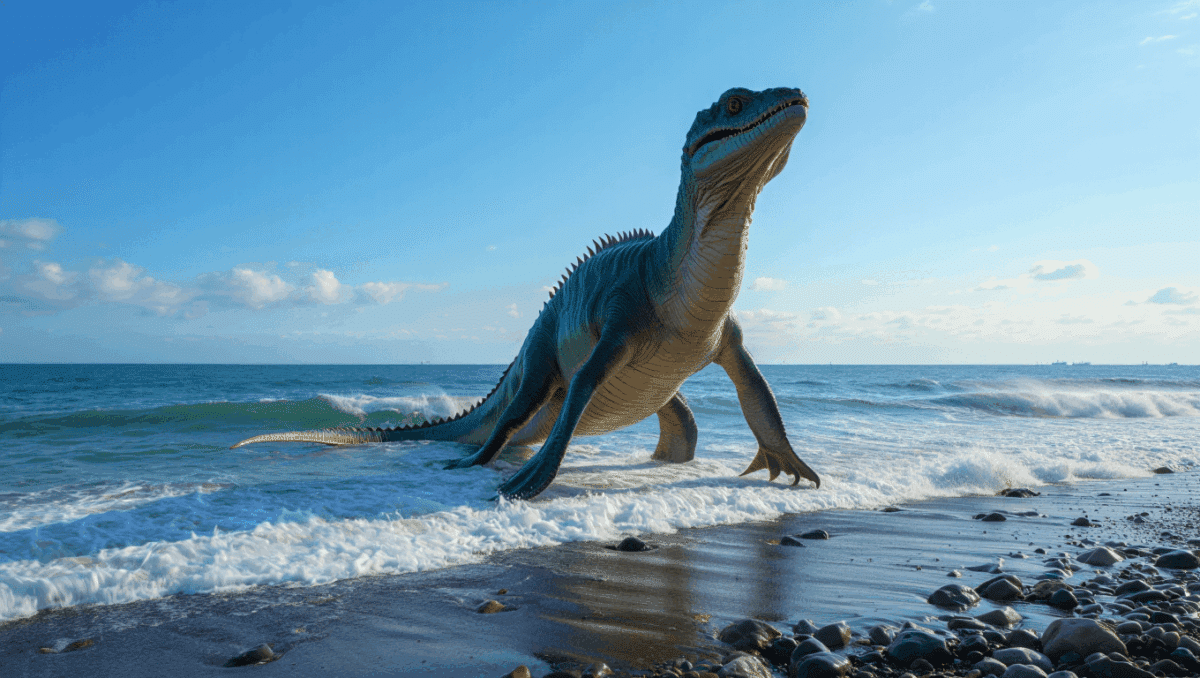
New fossil evidence is rewriting what scientists thought about some of the ocean’s most fearsome ancient creatures. Instead of living their entire lives below the waves, researchers now say at least one group of prehistoric marine predators regularly came ashore — behaving more like seals or crocodiles than fully aquatic fish.
The discovery shifts how paleontologists interpret limb bones, bone growth patterns and the sediments surrounding fossils. It also paints a more complex picture of how reptiles adapted to life at the water’s edge long before modern marine mammals evolved.
Clues from bones: how scientists tell a land-capable sea animal
The Growing Demand for Data-Driven Decision Making in Silicon Valley
He quit, ran out of money, and begged to come back — here’s how his boss reacted
Paleontologists combine several lines of evidence when deciding whether an extinct marine reptile could haul itself out of the water. In this case, the research team relied on:
- Bone microstructure — thickened or denser cortex in limb bones can indicate weight-bearing on land.
- Joint and limb anatomy — robust hip and shoulder joints, plus limb proportions, suggest capacity to support the animal’s weight outside water.
- Depositional context — fossils found in coastal or nearshore sediments, rather than deep marine layers, point to animals living close to shore.
- Taphonomic signals — signs of scavenging or weathering consistent with time spent exposed above water.
Which prehistoric sea predators are we talking about?
The study centers on a group of large marine reptiles traditionally thought to be fully aquatic. Until now, most of the evidence pointed toward life spent almost exclusively in open water: streamlined bodies, paddle-like limbs and tail adaptations for powerful swimming.
But careful reexamination of several well-preserved skeletons revealed anatomical details that are hard to reconcile with an entirely aquatic lifestyle. For example, some pelvic girdles show muscle-attachment scars consistent with powerful limb movements, and certain limb bones display the kind of reinforcement expected in animals that occasionally support their full body weight on land.
Why this matters for evolutionary biology
These findings complicate the tidy categories paleontologists often use—fully terrestrial, amphibious, or fully aquatic. Instead, the fossil record seems to preserve a spectrum of lifestyles. The ability to leave the water would have offered several selective advantages:
- Access to nesting beaches or protected shallow lagoons for birthing young
- A refuge from larger ocean predators
- Opportunities to scavenge or hunt for food along the shoreline
Being amphibious could therefore represent an ecological strategy, not just a transitional step, and may have evolved independently multiple times in different lineages.
Evidence drawn from modern animals and biomechanics
To interpret the ancient bones, researchers compared them with a wide range of living species. Crocodilians, seals, sea turtles and semi-aquatic birds all offer modern analogs that help scientists test functional hypotheses about movement and load-bearing.
Biomechanical modeling played a role as well. By simulating forces on fossil bones, the team could estimate whether limb and girdle structures were capable of supporting terrestrial locomotion. Those models suggested that at least some of these marine reptiles could support themselves on land for stretches long enough to nest, bask, or move between tidal pools.
Surprising finds in the sediment: where fossils were discovered
The geological setting of the fossils further supports an amphibious interpretation. Many specimens came from shallow coastal deposits, estuarine sands and deltaic aggregates rather than from deep-water shales where open-ocean species are typically preserved.
Details from the rock record reveal:
- Traces of tidal influence and rapid burial events
- Sedimentary structures associated with beaches and lagoons
- Occasional terrestrial plant debris mixed with marine shells
Taken together, the bones and the rocks point to animals that spent significant time at the shoreline, not just fleeting visits to shallow water.
Implications for reproduction, feeding, and ecology
If these creatures hauled out regularly, it changes hypotheses about how they reproduced and fed. Many modern marine reptiles and mammals return to land to nest or give birth. For prehistoric predators, coastal behaviors could have included:
- Nesting and egg-laying on beaches or in vegetated dunes
- Giving birth in protected shallow waters near shore
- Scavenging carcasses stranded at the tide line or preying on coastal animals
These behaviors would have altered predator-prey dynamics along ancient coastlines and may explain the presence of certain trace fossils and bone accumulations that previously puzzled researchers.
How this reshapes public images of “sea monsters”
Popular culture often freezes prehistoric marine predators as unstoppable, purely ocean-dwelling titans. This research paints a different portrait: animals flexible enough to exploit both sea and shore. That nuance helps us appreciate the diversity of life strategies that existed in ancient ecosystems and teaches a broader lesson about how life repeatedly adapts to shifting environments.
What scientists plan to do next
The study opens new avenues for investigation. Future work will focus on:
- Detailed histological sampling across more specimens to confirm patterns of bone remodeling
- Expanded biomechanical simulations incorporating soft tissues and whole-body dynamics
- A broader survey of coastal fossil sites to map the geographic extent of shore-use behavior
These steps will help determine whether amphibious habits were widespread or limited to specific places and times — and whether they correlate with climate shifts, sea-level changes, or competition with other marine predators.
You might also like:
- Ancient snake found in London museum: what we know
- 325 million years frozen: how two prehistoric giant sharks rewrote natural history
- 2-million-year-old elephant ancestor tooth found on beach by boy
- Ancient giant shark ruled the seas before megalodon, fossils reveal
- Platypus fossil reveals it swam with dolphins 25 million years ago

William Anderson is a multimedia producer specializing in videos, podcasts, and interactive galleries. With five years of immersive content creation, he turns information into a rich audio‑visual experience. His storytelling skills draw you directly into the heart of every story, on any platform.


Who woulda thought those sea monsters had a land-loving side, huh? Evolutions full of surprises, mate. Wonder if they rocked some dino-style shades while struttin on land. Now thats a sight!
Mate, aint evolution a wild ride? Those sea monsters struttin on land, imagine em rockin dino shades, blendin in with the cool crowd. Natures full of surprises, innit? Who knows, maybe they had a whole fashion show goin on back then. Cheers to the unexpected, mate!
I mean, could you imagine seeing a massive sea monster just strolling around on land like its no big deal? Thats some next-level evolution right there. Nature is wild, man. Just when you think youve seen it all, boom, prehistoric sea monster on land!
Dude, I feel you! Like, can you picture that sea beast just casually strolling around like its on a Sunday walk? Natures pulling out all the stops, man. Its like Mother Earths got a whole bag of tricks up her sleeve. Who knows whats next, right? Maybe well see flying sharks next!
Man, imagine a sea monster strollin on land back then! *chuckles* Natures full of surprises, aint it? Wonder how those ancient critters managed that switch-up. Evolutions a wild ride!
Man, imagine surfing and seeing a giant sea monster crawling onshore back in the day! Evolution is wild, aint it? Wonder if they had a secret society of land-loving sea creatures plotting world domination.
Dang, imagine a sea monster like, Nah, Im tired of this water life, lets check out the land scene! Respect to that adventurous spirit, you know? Evolution be wild, man.
Yo, imagine this sea monster being like, Nah, Im done with this water life, lets hit up the land scene! Thats some next-level evolution vibes right there, man. Like, who knew monsters could be so adventurous, right? Its like Mother Nature got a wild sense of humor or something. But hey, gotta give props to the sea monster for shaking things up, keeping it fresh. Who knows, maybe its onto something with this land exploration gig. Never a dull moment in the world of evolution, eh?
Man, can you imagine stumbling upon a sea monster from back in the day casually strolling on land? Like, Oops, wrong turn at the ocean! Evolutions got some epic tales to tell, for real.
I mean, can you imagine stumbling upon a sea monster just casually strolling on land back in the day? Like, Hey, Im tired of swimming, lets give these legs a whirl? Nature is wild, man.
Oh, so now sea monsters are making a land debut? Whats next, a T-Rex showing up in a ballet class? Evolutions got some wild plot twists, man. Cant wait for the sequel!
Oh man, imagine stumbling upon a sea monster trying to play landlubber! Bet it was like a fish outta water… literally. Makes you wonder what other wild stuff happened way back when, huh?
Man, imagine stumbling on a sea monster waddling on land back in the day! Thats like a mix of Jurassic Park and The Little Mermaid. Nature sure has some crazy plot twists up her sleeve!
Man, imagine a sea monster deciding to ditch the waves for a stroll on land. Evolutions full of surprises, huh? Bet itd look hilarious trying to walk on those fins. Natures got jokes!
I always knew those sea critters were up to something sneaky! First theyre swimming around, next thing you know, theyre strolling on land like they own the place. Cant trust those ancient sea monsters, man.
Mate, imagine a sea beast deciding to hit the gym and swap fins for legs! Evolutions wild ride. Can you picture the scene? Like, Hey, Im tired of swimming, lets give land a shot! Natures surprises, eh?
Dang, imagine strolling around back then and bumping into a sea monster trying out the land life! Bet those ancient folks had quite the surprise. Wonder if it was a chill monster or a grumpy one…
Oh, youre telling me those sea monsters were out here trying to be landlubbers? Whats next, mermaids walking around with legs? Evolutions a wild ride, man. Cant wait to see what else scientists dig up!
Whoa, imagine a sea monster trading waves for grass! Thats wild! Bet it looked like a dino-fish out of water. Science keeps blowing my mind with these ancient creature shenanigans.
I remember watchin this nature documentary where they talked bout how sea creatures evolved into land dwellers. Its wild to think bout those prehistoric times, like some sea monster takin a stroll on land – talk bout a fish outta water!
Man, imagine strolling by the shore and bumping into a sea monster on its way to conquer the land! Evolution is wild, aint it? From swimming to strutting, talk about a glow-up!