
Show summary Hide summary
- How the “astronaut” story convinced an elderly victim
- Not an isolated gimmick: similar scams keep appearing
- The bigger picture: romance and impersonation fraud on the rise in Japan
- How police describe the scammer’s tactics
- Practical steps to avoid falling for romance and impersonation scams
- Public reaction and social media fallout
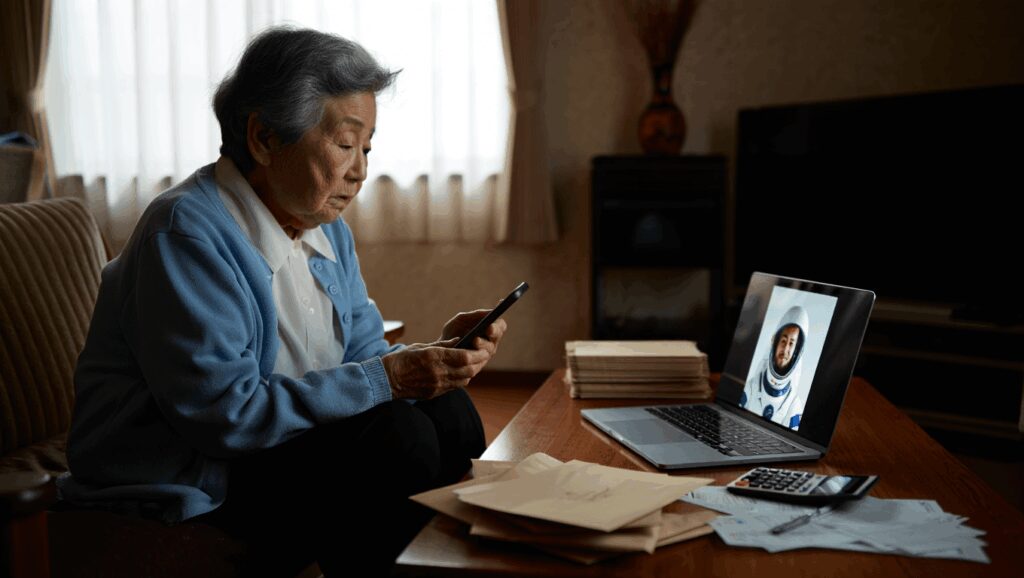
An 80-year-old woman in Hokkaido sent the equivalent of about $6,800 to a person she met online after believing he was an astronaut stranded in orbit. The messages painted an urgent picture — a professional in space running out of oxygen — and what began as friendly conversation turned into costly trust.
Local police say the story unfolded over weeks on social media, where a stranger cultivated a close relationship with the woman before pressing for money. By the time she realized something was wrong, the funds were gone.
How the “astronaut” story convinced an elderly victim
The Growing Demand for Data-Driven Decision Making in Silicon Valley
He quit, ran out of money, and begged to come back — here’s how his boss reacted
Investigators describe the scheme as a classic romance scam dressed up in spaceflight language. The perpetrator reportedly claimed to work for a national space agency and slowly built rapport through repeated messaging. Once emotional trust was established, the scammer introduced a manufactured emergency — his spacecraft was allegedly damaged and air supplies were dwindling — and asked for funds to stay alive.
Step-by-step of the con
- Initial contact through social media, often via private messages.
- Frequent, personalized messages that create a sense of intimacy and loyalty.
- A sudden crisis that requires immediate money to resolve — in this case, an “oxygen” shortage.
- Requests for electronic transfers or e-money, making recovery difficult once sent.
Police confirmed the payment was made using an electronic money service, a common channel in modern scams because it allows quick, irreversible transfers. The woman later reported the loss to authorities only after the money had disappeared.
Not an isolated gimmick: similar scams keep appearing
Authorities say this orbital ruse is only one variant of a wider trend. In a separate 2022 case, a Japanese woman was persuaded to send roughly 4 million yen — about $27,000 — after being told a Russian astronaut needed help covering “rocket fees” so the couple could marry once he returned to Earth.
Why these narratives work
- They combine romance with drama: loneliness meets an urgent life-or-death scenario.
- Appealing to national pride or professional credibility (e.g., posing as a JAXA employee) builds legitimacy.
- Slow relationship-building reduces skepticism and primes victims to act quickly when the “crisis” hits.
The bigger picture: romance and impersonation fraud on the rise in Japan
Romance scams are increasing sharply. Official figures show more than 20,000 reported cases in 2024, with total losses reaching 71 billion yen — roughly $480 million. The pace of incidents continued into 2025, with the first half of the year already exceeding the prior year’s total. Most reported victims are seniors, but younger adults are targeted too.
- Majority of victims: people aged 65 and older.
- Significant number of frauds: nearly 40% of people deceived by impersonation scams (like fake police) were in their 20s and 30s.
No demographic is immune. Scammers vary their narratives and platforms to match different targets, blending emotional manipulation with technical savvy.
How police describe the scammer’s tactics
Law enforcement officials outline a familiar pattern: the scammer mixes loneliness, urgency, and apparent authority to disarm the target. In this case, presenting as a space agency employee added a veneer of prestige. Weeks of messages created emotional dependence before the staged emergency demanded cash.
Red flags investigators point to
- Requests for money that arrive suddenly after a period of intense messaging.
- Insistence on electronic money transfers or one-way payment methods.
- Stories that rely on secrecy, urgency, or improbable professional circumstances.
- Refusal to meet in person or use video calls that verify identity.
Practical steps to avoid falling for romance and impersonation scams
Authorities urge people to be skeptical and to check details before sending funds. Below are concrete actions that can reduce risk.
- Verify identities: Ask for verifiable credentials, and insist on real-time video calls. Cross-check details against official sources when someone claims to represent an institution like JAXA.
- Question urgency: Scammers manufacture crises to force quick decisions. Slow down and consult a trusted friend or family member.
- Avoid irreversible payments: Be wary of e-money and wire transfers that are nearly impossible to recover.
- Report early: If you suspect a scam, contact local police and your financial provider immediately to try to halt transactions.
- Educate older relatives: Many victims are seniors; regular conversations about online safety can help prevent losses.
Public reaction and social media fallout
The Hokkaido case drew a wide range of responses online, from incredulous mockery to sincere sympathy. For many observers, the episode underscored how emotional vulnerability can be exploited under the guise of romance. For law enforcement, it’s another reminder that evolving scams require ongoing public awareness campaigns.
While the details differ from case to case, the pattern is familiar: a fabricated identity, a staged emergency, and the swift disappearance of money sent in good faith. Only the story’s author changes — the cost to the victim is real and immediate.
You might also like:
- Deepfake AI pastors scam churchgoers out of donations
- Tenga data breach exposes sex toy user data
- Heroic Lifeguards Save Mother and Son from Drowning in River: A Courageous Rescue Story
- NASA postpones ISS spacewalk after astronaut medical issue
- 12-year-old saves mom’s life after she passes out while driving, takes wheel and calls 911

William Anderson is a multimedia producer specializing in videos, podcasts, and interactive galleries. With five years of immersive content creation, he turns information into a rich audio‑visual experience. His storytelling skills draw you directly into the heart of every story, on any platform.


Dang, that fake astronaut scam is wild! Reminds me of the time I fell for a too-good-to-be-true deal. People can be sneaky, but gotta stay sharp! Trust but verify, folks.
Man, scammers are really getting creative these days! Pretending to be an astronaut running out of oxygen? Thats a whole new level of low. Poor woman, hope she gets her money back. Watch out for those smooth-talking fraudsters, folks!
Man, scammers really out there! Who knew pretending to be an astronaut was the new hustle? $6,800 for fake space drama? Hope they catch that con artist soon!
Man, scammers will stop at nothing! Fake astronaut running out of oxygen? Thats a new low. Poor lady losing all that cash. Hope they catch that con artist soon. Watch out for those wild stories, folks!
Man, scammers be getting bold these days! Pretending to be an astronaut running out of oxygen? Thats a whole new level of low. Poor woman lost $6,800. Hope they catch these scumbags soon.
Man, scammers will do anything these days! Pretending to be an astronaut in distress? Thats some next-level con artistry. But hey, gotta give it to them for creativity, even though its totally messed up. Watch out for those space-themed schemes, folks!
Man, scammers will do anything for a quick buck, huh? Pretending to be an astronaut running out of oxygen? Thats some next-level con artistry. Poor lady lost a good chunk of change. Stay woke, folks.
Geez, talk about hitting rock bottom for a quick buck! I mean, pretending to be an astronaut? Thats like playing poker with a deck of Uno cards. Poor lady got swindled big time. Gotta keep those eyes peeled, folks. Scammers be getting more creative than a Picasso painting these days.
I mean, come on, if someones spinning you a yarn about being an astronaut in distress, you gotta raise an eyebrow or two. $6,800 down the drain cause of a fake spaceman? Thats a whole new level of wild storytelling, folks.
Man, scammers will do anything for a quick buck! Pretending to be an astronaut running out of oxygen? Thats a new low. Hope they catch this fraudster soon and get the money back to the victim.
Dude, for real! These scammers are getting more creative by the day. Pretending to be an astronaut in distress? Thats a whole new level of low. Hope they nail this crook soon and give the victim their cash back. Despicable!
Man, scammers these days are next-level creative, huh? Pretending to be an astronaut running out of oxygen to con someone? Thats a wild scheme. Gotta give them points for originality, but also, like, seriously, $6,800? Thats just low.
Man, scammers these days really bringin out the big guns, huh? An astronaut in distress? Thats some Hollywood-level drama right there! But seriously, $6,800 is just plain dirty. At least be creative and ask for a trip to the moon or somethin, right?
Man, scammers be getting more creative by the day! Fake astronaut running out of oxygen? Thats bold! Gotta give them points for imagination, but messing with peoples money aint cool. Stay vigilant, folks!