
Show summary Hide summary
- How astronomers zeroed in on 3I/ATLAS
- What researchers were actually looking for — and why
- Observations and methods used in the search
- What the team found — limits instead of a discovery
- Why non-detections still matter for SETI and planetary science
- What researchers will do next and how future searches will improve
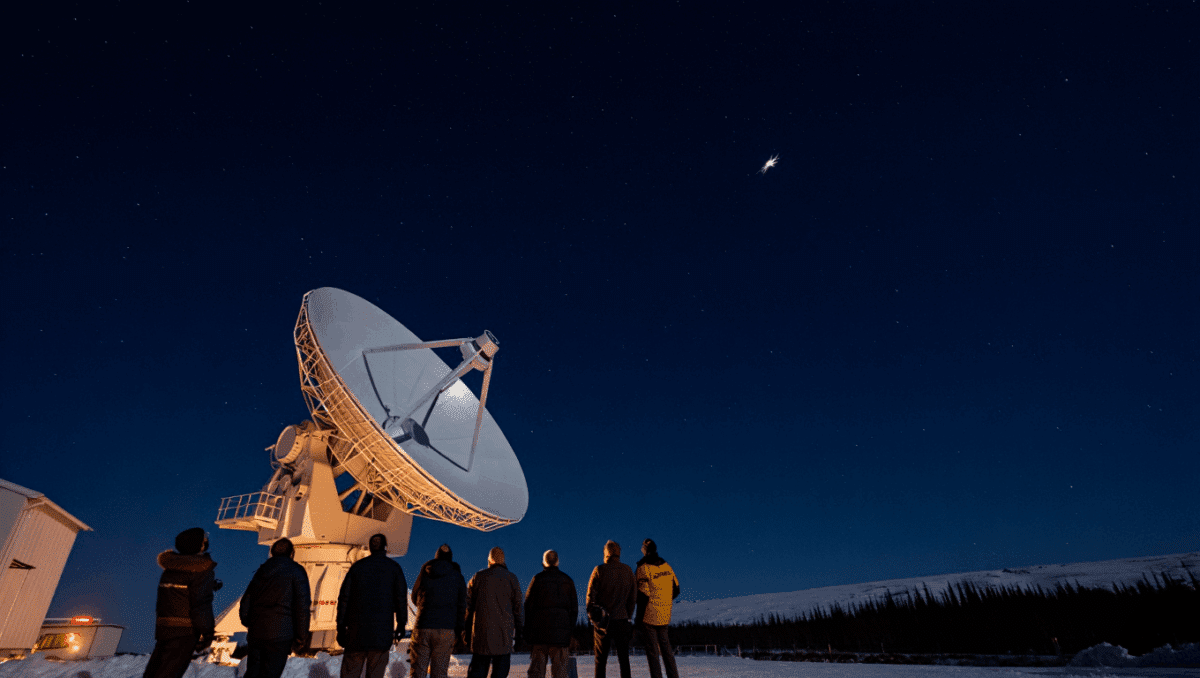
A faint, fast-moving speck in the sky prompted a flurry of observations and a familiar question: could this interstellar visitor be broadcasting signs of intelligent life? Astronomers trained radio dishes and optical instruments on the object known as 3I/ATLAS to search for artificial signals and unusual activity. The result: no smoking-gun evidence of extraterrestrial technology, but the observations tightened the limits on what might be hiding in plain sight.
How astronomers zeroed in on 3I/ATLAS
Scientists detected 3I/ATLAS with an automated survey and quickly coordinated follow-up observations across facilities. Because objects arriving from outside our solar system pass quickly and on steep trajectories, the window for detailed study is short. Teams raced to gather spectra, images, and radio data while the object was still bright enough to observe reliably.
- Optical telescopes measured the object’s motion, brightness, and composition indicators.
- Radio observatories scanned broad and narrow frequency ranges looking for patterns inconsistent with natural emission.
- Observers monitored for unusual variability, flaring, or repeatable signals that could hint at engineered sources.
The Growing Demand for Data-Driven Decision Making in Silicon Valley
He quit, ran out of money, and begged to come back — here’s how his boss reacted
These complementary approaches aim to catch both deliberate transmissions and accidental leaks of technology. Rapid response is crucial because an interstellar body spends only a brief time in range for high-sensitivity measurements.
What researchers were actually looking for — and why
The search targeted several types of technosignatures, the observational fingerprints of technology rather than life itself:
- Persistent narrowband radio emissions that stand out from the broad-band noise of natural sources.
- Repetitive pulses or encoded patterns that would be unlikely to arise from astrophysical processes.
- Optical anomalies such as sudden brightening or reflective behavior suggestive of large structures or active propulsion.
Technosignature searches are guided by a balance between plausibility and detectability. Scientists favor signals that would be relatively easy to spot over interstellar distances — for example, a continuous narrowband carrier wave — but they also account for a range of potential transmitter powers and frequencies.
Observations and methods used in the search
Teams combined time on multiple instruments to cover different parts of the electromagnetic spectrum and to verify any putative detections. Typical steps included:
- High-resolution radio spectroscopy across target bands to pick out narrow features.
- Time-domain analysis to detect pulsed or modulated signals.
- Optical spectroscopy to identify gas emissions, dust signatures, or unusual surface characteristics.
- Cross-checks against known satellites, radar sources, and terrestrial interference to filter false positives.
Data quality and interference rejection were especially important. Many candidate signals can be traced to human-made sources, so careful vetting is needed before anything is labeled “unexplained.”
What the team found — limits instead of a discovery
The search did not produce a confirmed artificial signal from 3I/ATLAS. Observations showed no narrowband radio beacons or repeating patterns that would point to deliberate transmissions. Optical and spectral data also lacked anomalies that would strongly suggest engineered materials or propulsion activity.
Instead of a positive detection, scientists reported improved constraints on what could be present and remain undetected. In practice that means:
- Any high-power, continuously transmitting beacon on frequencies searched would have been detected; none was seen.
- If an artificial transmitter exists on the object, it would either have to be brief, highly directional, outside the observed frequency ranges, or below the sensitivity threshold of the instruments used.
- Natural explanations for the observed photometry and spectra fit the data better than speculative technological scenarios.
These results mirror previous SETI-style searches of interstellar visitors, which have also returned null results but established useful observational baselines.
Why non-detections still matter for SETI and planetary science
A null result doesn’t equate to failure. Non-detections refine search strategies and tell scientists where not to look or how powerful a signal would need to be to be visible. They also help prioritize resources for future interstellar encounters.
- Instrument sensitivity limits: Knowing what telescopes could and could not see during the encounter helps plan upgrades or different observing modes for next time.
- Search parameter space: Each study narrows the range of transmitter strengths, durations, and frequency bands that remain plausible.
- Operational lessons: Fast coordination between surveys and follow-up facilities improves the chances of catching transient or narrowly beamed signals.
The scientific value extends beyond SETI. Detailed observations of interstellar objects inform models of their origin, composition, and how such objects survive travel between star systems.
What researchers will do next and how future searches will improve
Teams are already cataloging the lessons learned from the 3I/ATLAS campaign to sharpen future responses. Planned improvements include:
- Faster alert and scheduling protocols so sensitive instruments can observe sooner.
- Wider frequency coverage in radio scans to reduce blind spots where a signal might hide.
- More coordinated multiwavelength campaigns to catch both engineered and natural anomalies.
Several upcoming facilities and survey projects promise more frequent detections of rare interstellar visitors, creating more opportunities for targeted technosignature searches. Each encounter adds data and improves the odds that a future observation will reveal something new.
You might also like:
- Bizarre comet stumps world’s most powerful telescopes
- 3I/ATLAS comet’s unusual tail points toward the sun
- Comet 3I/ATLAS moving strangely: scientists explain why
- Voyager 1 just sent a signal that could rewrite everything we know
- NASA laser sends terabits from beyond Mars in deep-space communications test breakthrough

William Anderson is a multimedia producer specializing in videos, podcasts, and interactive galleries. With five years of immersive content creation, he turns information into a rich audio‑visual experience. His storytelling skills draw you directly into the heart of every story, on any platform.


Man, the Universe is playing hard to get! But hey, keep diggin, science peeps. Maybe one day well stumble upon some little green buddies, or at least a cosmic postcard saying, Wish you were here! *wink*
Aight, so the Universe be playin hard to get, huh? I feel ya, science peeps! Keep hustlin for them cosmic secrets. Who knows, maybe one day well stumble upon them little green buddies or a cheeky Wish you were here postcard, right? *wink* Lets keep our telescopes and minds wide open! ✨
I remember when I thought aliens were gonna pop up any day now. But hey, science dont stop, and if they say no signs yet, I trust em. Still, wouldnt it be wild if we found E.T.s voicemail out there?
Man, these scientists are out there searching for aliens like its their full-time job! Cant blame em though, I mean who wouldnt wanna find some extraterrestrial pals to chat with? Maybe next time, aliens, maybe next time.
Man, I remember watching all those sci-fi flicks with aliens and stuff. Now scientists are out here saying no signs of extraterrestrial life on 3I/ATLAS? Bummer, was hoping for a close encounter of the third kind!
Dang, I hear ya! It’s like Hollywood got us all hyped up for E.T. and then reality hits us with a “nope, nada” on the alien front. Maybe they’re just playing hide and seek? Or maybe theyre out there sipping space lattes, avoiding us Earthlings like Monday mornings. Who knows, right? Always keeping us on our toes!
Man, those scientists mustve been so hyped to find some extraterrestrial buddies. Guess the universe isnt ready for us to mingle with aliens yet. Back to square one, folks! *cue the X-Files theme*
Man, these scientists always out there, hunting for aliens like its a cosmic Easter egg hunt. Zero signs of E.T. this time, just a lonely rock drifting in space. Maybe the aliens are just good at hide and seek, who knows?
Man, those scientists really went all out hunting for aliens, huh? Its like a real-life X-Files episode! But hey, no little green men this time. Maybe theyre just really good at playing hide and seek… or were all alone in this crazy universe.
I remember watchin those alien movies, hopin theyd be like E.T. or somethin. But guess what, scientists found nothin out there. Maybe aliens are just too good at hide-and-seek, huh?
Man, after all that hype, they found nothing alien-y? Bummer. I was ready for some funky green dudes to pop up. Guess the universe is keeping its secrets tight. Maybe theyre just not that into us? Who knows!
Man, they really had me at alien life, got me all hyped up thinking about little green men. But hey, still cool science, right? Gotta keep looking. Who knows, maybe E.T. is just really good at hide and seek.
Man, these astronomers be playing hide and seek with aliens again. Like, come on, just spill the space beans already. But hey, at least theyre out there looking, I guess. Keep peeping through them telescopes, folks!
Man, these scientists be out here searching for aliens like its some cosmic scavenger hunt. At least theyre narrowing it down, right? Maybe next time theyll find some extraterrestrial buddies hiding behind a moon or something.
Man, these scientists are like detectives of the universe, searching for signs of extraterrestrial life. Its like a cosmic game of hide and seek. But hey, at least were ruling out places where those aliens aint hiding!
I remember back in the day, we thought aliens were gonna pop up everywhere. Now, its just limits and no signs of life. Guess Ill stick to sci-fi movies for my alien fix.