
Show summary Hide summary
- Which telescopes are watching 3I/ATLAS and why it matters
- Unusual chemistry: record-breaking carbon dioxide levels
- Activity where comets are normally quiet — archival TESS findings
- Shape and structure: more cocoon than classic comet tail
- Wild-card ideas and cautious scientific debate
- Opportunities for close study as it moves through the inner solar system
- What scientists will be watching next
An object labeled 3I/ATLAS raced into astronomers’ view in July 2025 and immediately raised questions: it behaves like an icy comet but breaks many of the rules researchers use to classify visitors from deep space. Multiple space telescopes redirected their attention to this fast-moving interstellar traveler, and NASA has kept a close watch as teams scramble to decode its odd signals.
What makes 3I/ATLAS noteworthy isn’t just that it came from beyond our solar system — it’s the way it’s acting and what its light reveals about chemistry and structure. Observatories including the James Webb Space Telescope, Hubble, TESS and SPHEREx are combining observations to build a picture of an object that refuses to look ordinary.
Which telescopes are watching 3I/ATLAS and why it matters
The Growing Demand for Data-Driven Decision Making in Silicon Valley
He quit, ran out of money, and begged to come back — here’s how his boss reacted
Within weeks of discovery, the object became the focus of an international observing campaign. Each facility brings different strengths:
- Hubble Space Telescope — high-resolution imaging to examine shape and dust distribution.
- James Webb Space Telescope (JWST) — infrared spectroscopy to probe gases and ices.
- TESS — time-series and archival imaging that captured early activity far from the Sun.
- SPHEREx — spectral mapping designed to detect molecular signatures across infrared bands.
These combined datasets let scientists study both the object’s physical form and its volatile inventory. That matters because interstellar objects carry records of the environments where they formed — chemical fingerprints that tell a story no solar-system comet can.
Unusual chemistry: record-breaking carbon dioxide levels
Spectra from Webb and SPHEREx delivered a striking result: 3I/ATLAS displays an exceptionally high ratio of carbon dioxide to water ice compared with typical comets. Researchers describe this as the highest CO₂-to-water ratio ever measured in a comet-like body, a clue that its formation or evolutionary path differed radically from comets born around our Sun.
Why does this ratio matter? The balance of CO₂ and H₂O points to the temperature and location where ices condensed in the parent system. A CO₂-dominated inventory suggests either formation beyond a carbon-dioxide ice line in its home system or processing by energetic radiation or shocks that altered its volatile mix.
Activity where comets are normally quiet — archival TESS findings
TESS archival frames illuminated another oddity: the object began showing activity when it was approximately six astronomical units (AU) from the Sun — farther out than Jupiter. Most comets remain inert at that distance because water ice is frozen solid and sunlight is weak.
- Detection at ~6 AU indicates volatiles more volatile than water — like CO₂ or CO — are likely driving early outgassing.
- Early activity also suggests a different thermal history or a composition that makes the body more susceptible to sublimation when exposed to minimal solar heating.
Being visible at such distances allowed teams to gather a longer baseline of observations than usual, giving a rare opportunity to watch an interstellar visitor “wake up” as it heads inward.
Shape and structure: more cocoon than classic comet tail
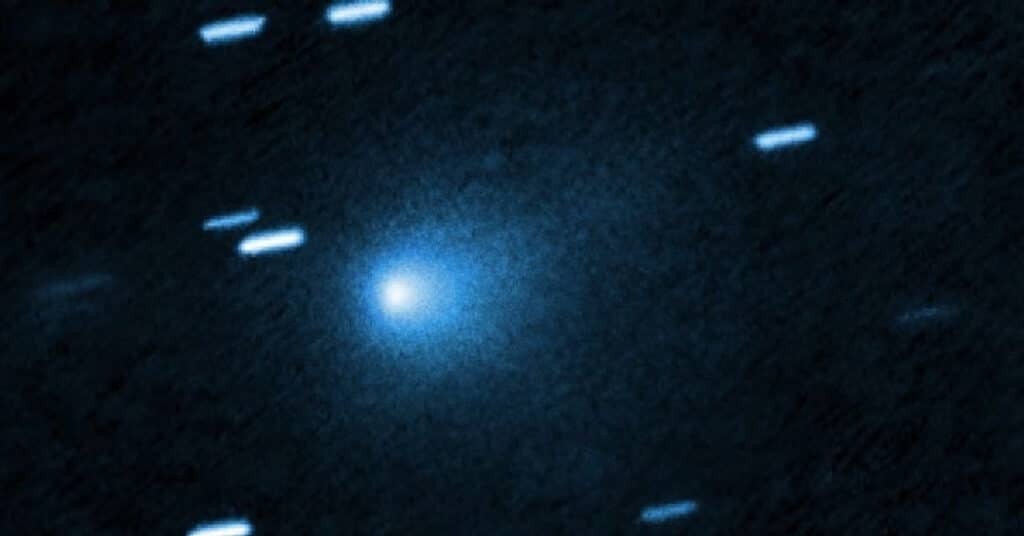
High-resolution Hubble images show a dust distribution that doesn’t match the textbook picture of a comet with a narrow, fan-shaped tail. Instead, the dust appears concentrated in a broad, asymmetrical envelope that some describers liken to a teardrop-shaped cocoon. That morphology changes how light scatters and how material is shed into space.
Possible explanations for the unusual shape include:
- Non-uniform surface activity, where localized vents eject material unevenly.
- A slow rotation or tumbling motion that spreads dust in asymmetric patterns.
- Interaction with the interstellar medium prior to arrival, which could have altered the outer layers.
Wild-card ideas and cautious scientific debate
Unconventional objects attract unconventional ideas. Harvard astronomer Avi Loeb has publicly proposed that 3I/ATLAS could be an engineered probe rather than a natural body — a hypothesis that captures headlines but remains speculative among most researchers. The mainstream scientific response is to favor natural origins while keeping an open mind as data accumulates.
Working hypotheses include:
- Formation near the CO₂ ice line in another planetary system, producing a CO₂-rich composition.
- Exposure to high levels of radiation or energetic particles that chemically altered the surface layers.
- Fragments from a larger parent body that experienced collisions or thermal processing before being ejected.
Scientists emphasize that extraordinary claims require extraordinary evidence, and so far the evidence points to a chemically unusual, physically asymmetric interstellar object rather than anything definitively artificial.
Opportunities for close study as it moves through the inner solar system
3I/ATLAS will make several passes through regions visited by our planets, presenting windows for additional observations. Its trajectory brings it near Mars, Venus and Jupiter on its inbound and outbound legs, allowing both ground-based and spacecraft assets to monitor changes in composition and structure.
- Juno and the Mars Reconnaissance Orbiter are potential platforms to obtain targeted measurements if geometry and mission operations permit.
- Ground observatories and amateur astronomers will track light curves and dust production to detect changes in rotational state or activity onset.
Each close approach offers a chance to refine models of how interstellar bodies behave under solar heating, or to catch transient phenomena that could answer why this visitor looks so different from native comets.
What scientists will be watching next
Teams are prioritizing high-resolution imaging, repeat spectroscopy across multiple wavelengths, and time-series photometry to capture evolving activity. Key questions guiding observations include:
- Will the CO₂/H₂O ratio change as the object moves closer to the Sun?
- Does the dust cocoon evolve into a more familiar tail, or does it disperse in an unexpected way?
- Can spacecraft encounters constrain the mass, density and internal structure enough to reveal its formation history?
Answers to those questions will come from sustained, coordinated observing campaigns. For now, 3I/ATLAS remains a fast-moving enigma that is rewriting some of the rules astronomers expected interstellar visitors to follow.
You might also like:
- Comet spins backward near sun, leaving scientists baffled
- 3I/ATLAS comet’s unusual tail points toward the sun
- Comet 3I/ATLAS moving strangely: scientists explain why
- 3I/ATLAS alien search: scientists find no signs of alien life
- Fastest-spinning asteroid discovered: what scientists know so far

William Anderson is a multimedia producer specializing in videos, podcasts, and interactive galleries. With five years of immersive content creation, he turns information into a rich audio‑visual experience. His storytelling skills draw you directly into the heart of every story, on any platform.


I remember back in 99 when Hale-Bopp was making headlines. Now this new comets stealing the show? Crazy stuff! Cant blame the telescopes for being stumped, I mean, who knew comets could be such divas?
Man, those telescopes must be feeling the cosmic FOMO right now! Bet theyre scratching their lenses, trying to catch a glimpse of the comet show. Gotta love when the universe throws us a curveball like this!
Man, this comets like that mysterious neighbor who never leaves the house. Whats it up to? Telescopes working overtime, but this comet plays hard to get. Intriguing chemistry, though. Whats its secret?
So, like, are we talking about the cosmic version of hide-and-seek here? This comets playing hard to get, huh? Telescopes be like, Where you at, 3I/ATLAS? Its like the ultimate game for scientists up there.
Dude, imagine playing hide-and-seek with a comet? Thats some next-level cosmic tag right there! Telescopes be like, Where you hiding at, 3I/ATLAS? Scientists up in space really turning stargazing into a thrilling game show. Who knew astronomy could be this fun?
I remember when I tried stargazing with my old telescope, hoping to catch a glimpse of something wild like this bizarre comet. But all I saw was a blurry mess! Guess I’ll leave it to the pros with their fancy telescopes.
I remember when I tried stargazing with my old telescope, but all I saw were blurry dots. Now theyre stumped by a bizarre comet? Maybe my telescope wasnt broken after all!
Dude, sounds like your telescope was just playing hard to get, huh? First, it gives you blurry dots, now its pulling an I told you so with a weird comet show. Who knew telescopes could have attitude? Maybe its time for a telescope relationship counselor, eh?
Man, this comets making the big shots sweat! A cosmic rebel, huh? Guess even the universe likes to keep us on our toes. Cant wait for the next twist in this space soap opera!
Man, I remember when I spotted a bizarre comet through my ol telescope. Thought I hit the jackpot, but these powerful telescopes got me beat. Makes me wonder what else is out there, yknow? Science is wild, dude.
Man, this comet is really throwing a cosmic curveball at those telescopes! Its like watching a sci-fi movie unfold in real life. Cant wait to see what other surprises the universe has up its sleeve!
Man, this comet is like the mysterious kid at school who never shows up to class but still gets straight As. Even the top telescopes are scratching their heads. Cant wait to see what other surprises this cosmic enigma has in store for us!
Man, comets are like the rock stars of space, right? Breaking records, defying expectations. Its wild how 3I/ATLAS is keeping the telescopes guessing. Just when you think youve seen it all, bam! Cosmic surprises.
Bro, totally! Comets are like the rock stars of the galaxy, just cruisin through space like they own the place. 3I/ATLAS is out here playin hide and seek with the telescopes, keeping everyone on their toes. Its like a never-ending cosmic game of peekaboo. Space is full of surprises, man. Just when you think youve got it all figured out, bam! Another comet struts its stuff, stealing the show. Space sure knows how to keep us entertained, huh?