
Show summary Hide summary
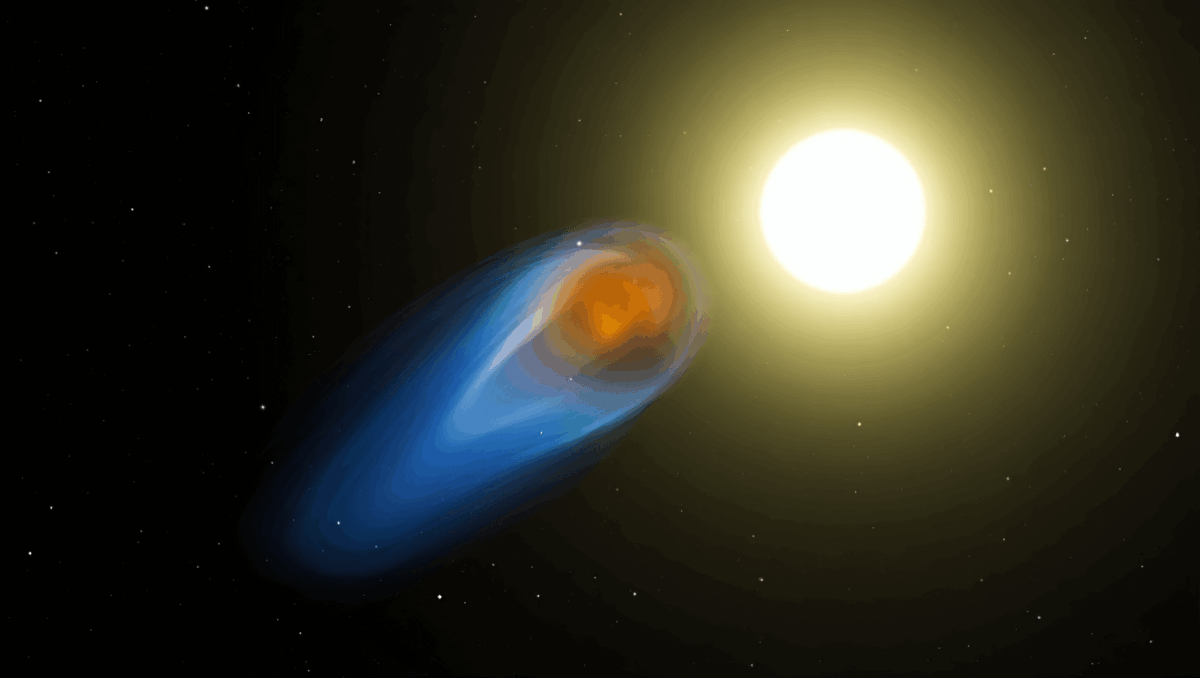
Comet 41P/Tuttle-Giacobini-Kresák surprised astronomers by doing something few small solar system bodies have been observed to do: it essentially stopped spinning and then began rotating in the opposite direction. The dramatic twist in its behavior was tracked by multiple space telescopes and has opened fresh questions about how comet activity—jets of vapor and dust driven by sunlight—can alter an object’s rotation so dramatically.
Scientists pieced together the event from observations taken during and after the comet’s 2017 close approach to the Sun. What began as a gradual slowdown accelerated into a near-complete halt and then a reversal, a sequence that challenges expectations about rotational changes in these icy relics of the early solar system.
What telescopes revealed about 41P’s unusual spin
The Growing Demand for Data-Driven Decision Making in Silicon Valley
He quit, ran out of money, and begged to come back — here’s how his boss reacted
NASA’s Swift spacecraft first flagged oddities in the comet’s rotation, and follow-up imaging by the Hubble Space Telescope provided the detail needed to measure how much and how fast the motion changed. Researchers tracked the comet’s rotation through light variations and direct imaging of the active nucleus.
- Early 2017: Observations recorded a spin period on the order of tens of hours.
- March–May 2017: The rotation slowed dramatically, increasing from roughly 20 hours to about 46 hours.
- By December 2017: Data indicated the nucleus was rotating again but in the opposite direction, with a period near 14 hours.
UCLA astronomer David Jewitt and colleagues analyzed Hubble’s images to reconstruct the sequence. The reversal wasn’t a small wobble—it was a large-scale change in angular momentum that required significant torque on the nucleus.
How comet jets can act like rocket thrusters
Comets are mixtures of rock, dust and volatile ices. When they approach the Sun, heat causes surface ices to sublimate and escape as gas, sometimes carrying dust with them. Those escaping materials can produce localized jets that push back on the nucleus.
Mechanics behind rotation changes
- Asymmetric outgassing produces uneven forces on the nucleus.
- If jets are concentrated in particular regions, they can apply sustained torque over weeks or months.
- Small nuclei are especially susceptible because less mass makes it easier to change spin rate or axis.
Jets don’t need to be continuous or uniform—sporadic bursts from freshly exposed ice or seasonal illumination can produce the cumulative effect needed to first slow a rotation, then halt it, and finally reverse direction. Most cometary spin variations are measured in minutes or hours; 41P’s change by tens of hours is exceptional.
Why the 41P flip matters for comet science and population studies
Large rotational jumps like 41P’s offer a rare window into the interplay between comet structure, activity, and longevity. Astronomers suspect such processes could influence how comets evolve or break apart.
- Spin-up from jets may fragment weak nuclei, creating more small comet fragments than expected.
- Conversely, spin-down episodes could temporarily stabilize an object, altering patterns of surface erosion.
- Understanding these dynamics helps refine models for comet lifetimes and for predicting when a comet might shed material or break up entirely.
One emerging idea is that many small comets observed today might be the products of prior objects that were spun to pieces by their own outgassing. If true, rotational dynamics become a key factor in the lifecycle of cometary bodies.
What astronomers will be watching in coming years
41P will return to the inner solar system in 2028, offering another opportunity to monitor its rotation and activity with improved instruments and broader surveys. Facilities coming online—most notably the Vera C. Rubin Observatory—will provide continuous, deep sky monitoring capable of catching rotational shifts and fragmentation events across many comets.
- Planned follow-ups will combine space telescopes and ground-based networks to measure nucleus rotation and jet behavior.
- Large sky surveys will help build a statistical picture: how common are extreme spin changes, and how often do they lead to breakup?
- Detailed studies of 41P and similar objects can help calibrate models of torques from asymmetric outgassing.
Keeping an eye on returning comets will let astronomers observe whether 41P repeats its dramatic behavior, settles into a new rotational state, or shows signs of progressive weakening or fragmentation. Continuous monitoring also increases the chance of catching other comets in the act of spinning up or down, which is essential for understanding how these small worlds die—or transform—under the Sun’s influence.
You might also like:
- Comet 3I/ATLAS moving strangely: scientists explain why
- 3I/ATLAS comet’s unusual tail points toward the sun
- Bizarre comet stumps world’s most powerful telescopes
- Fastest-spinning asteroid discovered: what scientists know so far
- Asteroids near Venus could devastate Earth and remain invisible to telescopes

William Anderson is a multimedia producer specializing in videos, podcasts, and interactive galleries. With five years of immersive content creation, he turns information into a rich audio‑visual experience. His storytelling skills draw you directly into the heart of every story, on any platform.


A conspiracy nut: Hold up, folks! Comet doin a funky dance near the sun? Whats NASA hidin this time? Secret alien rendezvous? I smell cover-up!
Man, that comet flip got me all turned around like a cat chasing its tail! Just when you think you got the universe figured out, it throws you a curveball. Gotta love space keeping us on our toes!
Man, these comet scientists must be scratching their heads now! One minute you think youve got the universe all figured out, then boom! A comet decides to do a 180 near the sun. Natures way of keeping us on our toes, huh?
Man, comets be wildin out here! Spinnin backwards near the sun like they own the place. Scientists must be scratchin their heads like, What in the universe is goin on with 41P? Gotta love space drama, right?
Yo, I feel you on that, dude! Comets actin all rebellious and doin their own thing up there. Scientists must be like, Come on, 41P, youre breakin all the rules! Space drama always keepin us on our toes, eh?
So, this comet be playin reverse uno near the sun, huh? Scientists scratchin their heads like, What in the galaxy is goin on here? Just when you think you got space all figured out, bam, plot twist!
Man, comets always keep us on our toes, huh? Just when you think youve got them figured out, BAM, they hit you with a reverse spin! Cant wait to see how the science peeps unravel this cosmic mystery. Exciting stuff, folks!
Who knew comets could throw such a cosmic curveball? Spin it backwards, and scientists are scratching their heads! The universe sure knows how to keep us on our toes. Whats next? Planets doing the moonwalk?
Man, I thought I had seen it all, but a comet spinning backward near the sun? Thats some wild cosmic stuff! Cant blame the scientists for being baffled, Im scratching my head too!
Man, comets be wildin! Spinnin backwards near the sun like they own the place. Can you imagine if we started doin that? Scientists better figure this out before the whole universe starts breakin the rules!
Man, comets be wildin out here! Spinnin backwards near the sun, leavin scientists scratchin their heads. You never know what these cosmic dudes are gonna pull next! *insert alien emoji*
A skeptic here, but this comets backward spin? Now thats a head-scratcher! Scientists must be pulling an all-nighter trying to crack this cosmic puzzle. Perhaps its a rebellious comet, fed up with the same-old orbit routine? Who knows!
I remember watchin a documentary bout space once, and lemme tell ya, this comet switcheroo is mind-bogglin! Can you imagine if we suddenly started spinnin backward on Earth? Thatd be a wild ride!
Man, these comets be wildin! Spinnin backwards near the sun like theyre breakdancin or somethin. Scientists must be scratchin their heads harder than a DJ with a bad mixtape. Space, you never cease to amaze!
Man, this comets got moves! Spinnin backward near the sun, leavin scientists scratchin their heads. Cant wait to see what other surprises space throws at us next! Its like a cosmic dance out there!
Man, aint space just full of surprises? Those comets be doing the cha-cha near the sun! Bet those scientists are like, What in the galaxy is going on here? Cant wait to see what other tricks space has up its sleeve. Its like a never-ending show out there!
Man, comets be wildin these days! Spinnin backwards near the sun? Thats some cosmic drama right there. Cant blame the scientists for scratchin their heads on this one. Space is one big ol mystery party, aint it?
Man, that comets like a cosmic rebel doing a moonwalk! Backwards spin near the sun? Talk about defying the laws of space physics. Cant wait for scientists to crack this mind-bending mystery.
Man, comets always pull a sneaky move! Its like they got a mind of their own, doing flips and spins near the sun. Cant blame the scientists for scratching their heads on this one. Space is full of surprises, huh?