
Show summary Hide summary
- How astronomers detected the smash-up and mobilized telescopes
- What the collision looked like — light, dust, and flying fragments
- What the collision teaches us about asteroid structure and strength
- Implications for solar system evolution and collisional cascades
- Why the finding matters for planetary defense and resource exploration
- Follow-up observations, laboratory work, and upcoming missions
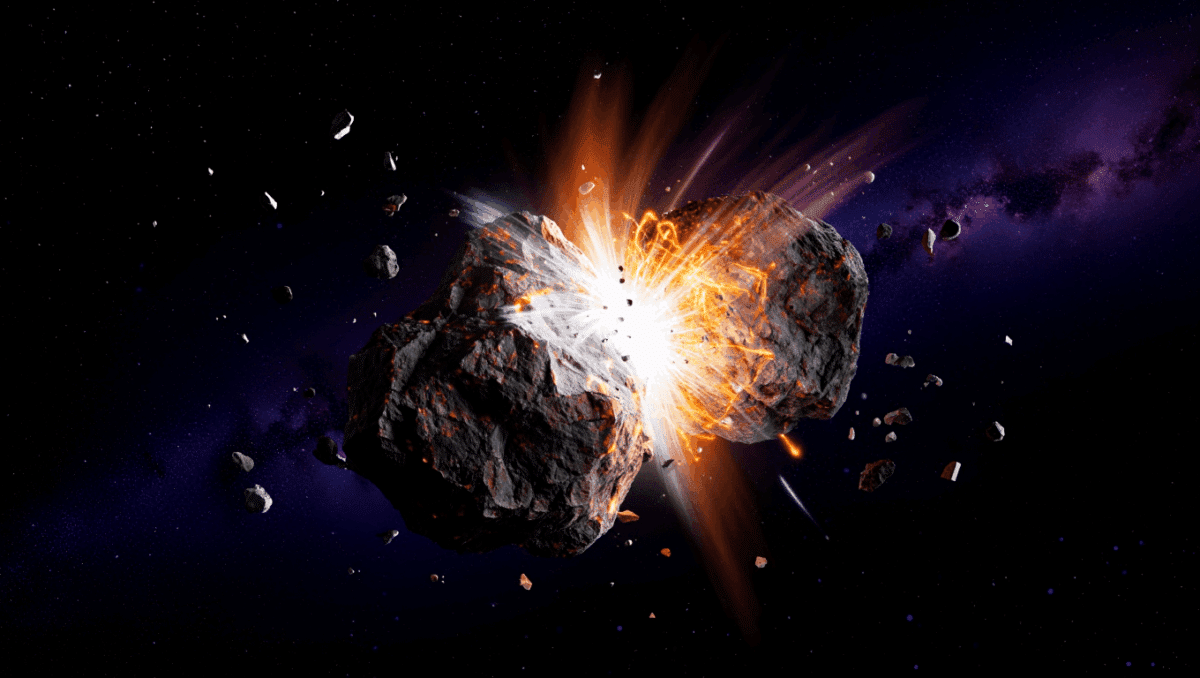
Astronomers have for the first time directly watched asteroids collide in real time, capturing dramatic light and debris as two rocky bodies smashed together in the asteroid belt. The observations, made with a network of ground- and space-based telescopes, give scientists a rare front-row seat to the kind of impacts that have shaped our solar system for billions of years — and offer new clues about the interior structure and life cycle of small bodies orbiting the Sun.
The event began as a faint, unexpected brightening in the main belt. Within hours, follow-up observations showed a cloud of dust and fragments spreading outward, revealing details about the collision angle, speed, and the composition of the objects involved. These data are already helping researchers refine models of asteroid disruption and informing efforts to protect Earth from potential hazardous impacts.
How astronomers detected the smash-up and mobilized telescopes
A routine sky survey flagged a sudden brightening of an asteroid-like object, triggering automated alerts that mobilized observers worldwide. Surveys that continuously scan the sky for moving objects — including Pan-STARRS, ATLAS, and the Zwicky Transient Facility — play a crucial role in spotting short-lived phenomena such as collisions.
The Growing Demand for Data-Driven Decision Making in Silicon Valley
He quit, ran out of money, and begged to come back — here’s how his boss reacted
Instruments that caught the event
- Wide-field survey telescopes identified the initial flash and tracked brightness changes over time.
- Optical and infrared observatories followed up to measure the dust plume and estimate fragment sizes.
- Space telescopes provided uninterrupted views free from atmospheric interference, revealing finer structural details.
Within hours of detection, professional and amateur astronomers pooled images and spectra to form a composite timeline, showing the immediate aftermath and development of the debris cloud. Rapid coordination between facilities allowed scientists to capture the earliest stages of the impact — a phase rarely seen and critically informative.
What the collision looked like — light, dust, and flying fragments
Observations documented a sudden increase in brightness followed by a sustained glow as dust and small fragments reflected sunlight. High-resolution images showed complex features inside the expanding cloud: bright clumps, streaks of ejecta, and a trail that extended along the object’s orbit.
Key observed features:
- A sharp peak in optical brightness corresponding to the moment of contact.
- A multi-component dust cloud with different grain sizes spreading at varying speeds.
- Detached fragments on independent orbits, suggesting significant energy transfer during impact.
Spectroscopy revealed signatures of silicates and metal-bearing minerals, offering a window into the asteroids’ composition. By measuring how starlight changed after passing through the cloud, scientists estimated the dust particle sizes and inferred that the collision produced both fine grains and larger centimeter-to-meter scale fragments.
What the collision teaches us about asteroid structure and strength
Asteroid collisions serve as natural experiments for testing theories about the internal makeup of these bodies. Was the impacted object a monolithic rock, a loosely bound rubble pile, or a layered body with a fractured core? The observed ejecta pattern and fragment velocities provide answers.
Models suggest:
- If fragments dispersed at lower speeds, the parent body was likely a weakly bound rubble pile.
- High-velocity ejecta imply a more coherent, rock-like structure.
- Asymmetric debris patterns point to oblique impacts rather than head-on collisions.
Initial analysis favors a partially consolidated interior with areas of weak cohesion, consistent with previous missions that have visited small asteroids and found porous, mixed-porosity structures. This matters because an asteroid’s internal strength affects how it will break apart under stress — a critical parameter for deflection strategies and for interpreting the history of collisions in the asteroid belt.
Implications for solar system evolution and collisional cascades
Collisions like this are the engine of change in the asteroid belt, grinding large bodies into smaller ones and feeding dust into interplanetary space. Over geological time, repeated collisions generate a collisional cascade that shapes the size distribution of asteroids and supplies the zodiacal dust cloud visible from Earth.
Observational implications:
- Freshly created fragments can seed new asteroid families — groups of objects sharing similar orbits and compositions.
- Dust production rates measured from the event help calibrate models of the zodiacal light and inner solar system dust population.
- Understanding fragmentation thresholds refines estimates of how often catastrophic breakups occur.
By comparing this event to computer simulations, researchers can better estimate the frequency of similar collisions and their contributions to the overall debris budget of the solar system.
Why the finding matters for planetary defense and resource exploration
Watching an asteroid collision in real time has direct relevance for protecting Earth and for planning missions that may tow, deflect, or mine small bodies. Knowledge of how asteroids fragment and what materials they release informs both hazard assessment and engineering approaches.
Practical takeaways:
- Deflection techniques must account for rubble-pile behavior; pushing or blowing off surface material may have unintended consequences.
- Fragmentation models affect impact risk assessments for Earth-crossing debris produced by such collisions.
- Resource extraction strategies hinge on whether an asteroid is cohesive rock or a loose aggregate of material.
Real-world data from a direct collision offers far more reliable constraints than laboratory experiments or scaled simulations alone.
Follow-up observations, laboratory work, and upcoming missions
Now that the immediate fireworks have faded, teams are planning long-term follow-up to track fragments and monitor the dispersion of dust. Key next steps include continuous orbit determination, thermal infrared monitoring to measure particle sizes and temperatures, and targeted spectroscopy to identify any fresh, unweathered material exposed by the impact.
What researchers will focus on:
- Mapping the trajectories of individual fragments to determine mass and energy distribution.
- Measuring how sunlight affects small particles (the Yarkovsky and radiation-pressure effects).
- Comparing collision remnants with meteorite samples to link asteroid families to known meteorite types.
Laboratories will recreate impact conditions and analyze recovered meteorites to validate interpretations from the telescopic data. Meanwhile, upcoming missions that visit small bodies will use these observations to refine sampling strategies and safety protocols. The data from this collision will feed into mission planning, including trajectory design and surface-interaction models, ensuring future spacecraft can handle the complexities revealed by this real-time cosmic crash.
You might also like:
- Fastest-spinning asteroid discovered: what scientists know so far
- Asteroids near Venus could devastate Earth and remain invisible to telescopes
- Asteroid could hit the moon in 2032: what we know
- NASA may nuke an asteroid to save the moon
- Comet spins backward near sun, leaving scientists baffled

William Anderson is a multimedia producer specializing in videos, podcasts, and interactive galleries. With five years of immersive content creation, he turns information into a rich audio‑visual experience. His storytelling skills draw you directly into the heart of every story, on any platform.


Man, that asteroid smash-up got me thinking about the fragility of our lil planet. Makes you wonder about our place in the universe, yknow? Hope those telescopes keep bringing us mind-blowing discoveries!
Man, this asteroid collision thing… Reminds me of that time I accidentally knocked over my grandmas vase. Debris everywhere. But hey, at least astronomers can learn something about asteroids from this cosmic smash-up, right? Silver lining, I guess.
Man, that asteroid collision is like a cosmic game of billiards! Who knew space could get so rowdy? Imagine being the astronomers catching that live action. Bet they were hyped! Space junk flying everywhere, talk about a show!
Man, space is wild! I mean, asteroids smashing into each other? Talk about a cosmic showdown! Makes you wonder what else is happening out there that we havent even caught a glimpse of yet. Exciting stuff, for sure.
Man, talk about a cosmic showdown! Reminds me of that time I accidentally knocked over my friends science project. But hey, at least astronomers got a front-row seat to an asteroid smash-up, right? Natures fireworks!
Man, that asteroid collision got me thinkin of that time I dropped a plate in the kitchen. But instead of shards, we got cosmic debris! Wild how astronomers caught that smash-up live. Got me watchin the skies closer now.
Man, asteroids be throwing a wild party up there! Imagine being like, Oh, just another day observing space, and boom, asteroid collision! Astronomers mustve been hyped to see that celestial drama unfold.
Dang, thats like the ultimate cosmic party crasher, huh? I can picture those astronomers with their telescopes, popcorn in hand, ready for some out-of-this-world action! Its like watching a blockbuster movie, but with real-life asteroids stealing the show. Wonder if they had some intergalactic popcorn too!
I mean, imagine seeing an asteroid collision – wild stuff! Reminds me of when I accidentally knocked over my grandmas vase. But, like, on a cosmic scale. Props to astronomers for catching that action!
A nostalgic parent: My kids were amazed by that asteroid news! Reminds me of sci-fi movies we watched. Its wild how science brings the universe closer. Maybe theyll grow up to explore space, who knows?
Man, that asteroid news really took me back! I remember watching those same sci-fi movies with my kids. Its insane how science keeps blowing our minds and making the universe feel within reach. Who knows, maybe our little ones will be the ones exploring space someday. The future is wide open, aint it?
Man, talk bout cosmic fireworks! This asteroid smash-up is like Mother Natures own action movie. Cant believe astronomers caught that epic collision live. Space is wild, yall!
Man, that asteroid collision was like a cosmic action movie unfolding in real-time! Can you imagine the sheer power and force at play up there? Its like natures own fireworks show, but on a whole other level. Mind-blowing stuff!
Man, talk about a cosmic showdown! Reminds me of that time I saw two squirrels duke it out over an acorn. But hey, asteroids colliding? Thats some next-level drama up there in space! Wonder what else is brewing out in the universe…
Oh man, talk about a cosmic show! Imagine being an asteroid, minding your own business, then BAM, collision time! Its like a space soap opera up there. Cant wait for the next episode!
Man, that collision was like a cosmic fireworks show! I mean, asteroids crashing into each other? Thats some next-level drama. Wonder if they had a space road rage incident or just playing interstellar bumper cars.
Dude, that space crash was wild, like a freakin fireworks display on Jupiter! Maybe those asteroids were just having a bad cosmic day, who knows? But seriously, interstellar bumper cars? Thats a whole new level of extraterrestrial drama, man. Wonder if they were running late for a space party or just had a case of space road rage. Space traffic jams must be a nightmare!
Man, did you see that asteroid collision? Its like a cosmic demolition derby out there! Makes you wonder what else is happening in the vastness of space. Imagine being an asteroid, minding your own business, then boom! Collision course. Wild stuff.
Man, talk bout fireworks in space! I mean, an asteroid smash-up? Thats like straight outta a sci-fi flick! Makes you wonder what else is poppin off up there, right? Space never fails to surprise.
Dude, totally! That asteroid showdown was like a scene from an epic space showdown flick! Cant help but think, what other crazy stuff is going down up there, right? Space be throwin surprises left and right. Its like a never-ending show!