
Show summary Hide summary
- What the new observations uncovered about Betelgeuse
- How astronomers pieced together the picture
- Why this matters for our understanding of red supergiants
- Possible drivers of the complicated mass loss
- Key measurements and what they revealed
- What astronomers plan to do next
- What this means for observers and the public
- Unresolved puzzles and the scientific payoff
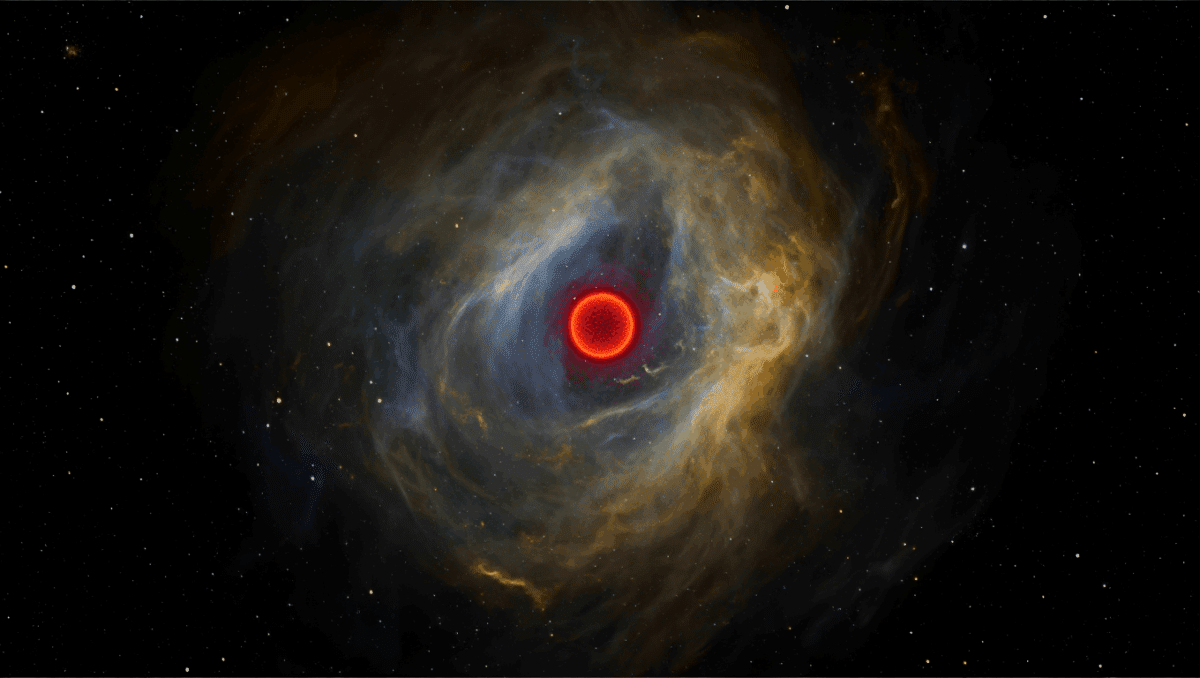
Betelgeuse, the familiar red shoulder of Orion, has been hiding something much bigger than astronomers expected. New high-resolution observations reveal a vast, complex structure of material around the star—an unexpected reservoir of gas and dust that changes how scientists think this famous red supergiant loses mass and prepares for its final act.
This discovery adds a fresh chapter to the star’s recent mysteries, including the dramatic “Great Dimming” in 2019–2020. The new data give astronomers a clearer look at the chaotic environment around Betelgeuse and suggest the star is shedding matter in ways that were previously unrecognized.
What the new observations uncovered about Betelgeuse
Researchers using a combination of submillimeter and infrared telescopes mapped an extended envelope of material stretching far beyond the star’s visible surface. Rather than a uniform wind, the structure appears clumpy and asymmetric, with dense knots and filamentary streams of dust and molecular gas. These features form a massive, irregular shroud that may hold a substantial fraction of the material the star has expelled in recent centuries.
The Growing Demand for Data-Driven Decision Making in Silicon Valley
He quit, ran out of money, and begged to come back — here’s how his boss reacted
- Large, asymmetric shell: Observations show an envelope that is not spherically symmetric but instead shaped by localized ejections and directional plumes.
- Dense clumps and filaments: The surrounding material includes pockets of higher density capable of forming dust and absorbing starlight, which helps explain episodes of sudden dimming.
- Extended reach: The detected matter stretches a long way from the photosphere, implying sustained or episodic mass-loss events over long timescales.
How astronomers pieced together the picture
The team combined data from millimeter-wave arrays and high-contrast infrared imagers to probe different components of the environment. Millimeter observations are sensitive to cold molecular gas and thermal emission from dust, while infrared instruments reveal scattered light and hotter dust closer to the star.
Techniques and instruments that mattered
- Interferometry at submillimeter wavelengths provided the spatial resolution needed to resolve structures only a few astronomical units across.
- Adaptive-optics infrared imaging traced the distribution of warm dust and surface features on the star itself.
- Spectral line data allowed measurement of gas velocities, showing material moving at different speeds and directions—evidence for localized eruptions rather than a smooth, steady wind.
This multiwavelength approach was key: by layering snapshots that probe different temperatures and densities, astronomers rebuilt a three-dimensional view of Betelgeuse’s circumstellar environment.
Why this matters for our understanding of red supergiants
Betelgeuse is an archetype for the late-life behavior of massive stars. How it loses mass affects core evolution and the star’s path to supernova. The discovery of a massive, structured shell challenges simplified models that assume steady, spherical mass loss.
- Impacts on supernova timing: Uneven, episodic mass loss can change the star’s remaining lifetime by altering how quickly the core sheds angular momentum and envelope mass.
- Explosion environment: The distribution of gas and dust around the star will shape the light and spectra of any future supernova, affecting how shock waves propagate and how early emission is absorbed or reprocessed.
- Dust production in galaxies: Red supergiants are major dust factories. Finding more dust in the immediate surroundings of Betelgeuse raises questions about how efficiently such stars seed the interstellar medium.
Possible drivers of the complicated mass loss
Astronomers are considering several mechanisms that could create the uneven structure seen around Betelgeuse:
- Giant convective cells in the star’s outer layers launching localized plumes of gas.
- Surface magnetic activity channeling and accelerating outflows in preferred directions.
- Pulsational instability—periodic expansions and contractions—coupled with radiative cooling that allows dust to form episodically.
- The influence of a distant companion or past close encounter that disturbed the envelope (still speculative and under study).
Each explanation carries different signatures in velocity measurements and chemical composition, so continued spectral monitoring will help narrow the options.
Key measurements and what they revealed
Spectral profiles show multiple velocity components, meaning parts of the envelope are moving at distinct speeds relative to the star. Temperature estimates indicate coexistence of hot dust close to the photosphere and much colder material farther out. The inferred mass of the envelope is surprisingly large for recent mass-loss episodes, suggesting either unusually intense ejections or accumulation from many prior events.
These measurements point to an active, evolving circumstellar environment rather than a calm, steady wind.
What astronomers plan to do next
Follow-up observations are already being scheduled to monitor changes over time and to map the envelope in greater detail. Key goals include:
- Tracking the motion of clumps to determine whether they are bound, falling back, or escaping the star.
- Measuring chemical abundances in different parts of the shell to understand dust formation processes.
- Using time-domain imaging to link surface events on the star with subsequent mass ejections into the envelope.
New campaigns will take advantage of next-generation facilities and coordinated multiwavelength monitoring to capture Betelgeuse’s evolving behavior with unprecedented clarity.
What this means for observers and the public
Betelgeuse has long been monitored by professionals and amateurs alike because its brightness variations can be dramatic. The realization that the star is surrounded by a far more massive and structured envelope than thought reshapes expectations: future changes in brightness may now be interpreted as interactions between the star and its circumstellar material, not just intrinsic surface variations.
For the wider astronomy community, Betelgeuse is evolving into a natural laboratory for studying mass loss, dust formation, and the pre-supernova environment of massive stars.
Unresolved puzzles and the scientific payoff
Although the new findings answer some questions, they raise many others. How often do red supergiants produce such asymmetric envelopes? Are features like Betelgeuse’s massive shroud common but historically undetected because of limited resolution? Resolving these puzzles will improve models of stellar evolution and refine predictions for how massive stars end their lives.
You might also like:
- Butterfly Nebula image captured by Gemini telescope reveals glowing gaseous wings
- Lemon-shaped exoplanet challenges planet formation models
- 3I/ATLAS comet’s unusual tail points toward the sun
- Bizarre comet stumps world’s most powerful telescopes
- asteroid collision observed: astronomers see debris cloud and brightness changes

William Anderson is a multimedia producer specializing in videos, podcasts, and interactive galleries. With five years of immersive content creation, he turns information into a rich audio‑visual experience. His storytelling skills draw you directly into the heart of every story, on any platform.


Man, Betelgeuse is like that mysterious neighbor whos finally showing their cards. Astronomers really be playing cosmic detective, unveiling secrets bigger than any soap opera plot. Cant wait for the next episode!
No way, man! Betelgeuse spilling its secrets? That stars like a cosmic mystery box, always keeping us on our toes. Cant wait to see what other cosmic bombshells these astronomers uncover next!
I remember stargazing with my grandpa, and Betelgeuse always stood out, yknow? Now, astronomers spillin the cosmic tea on its secrets? Thats some next-level stargazing drama, man. Cant wait for the popcorn!
I mean, Betelgeuse keeps surprising us, right? Its like that friend whos always got some drama going on. But hey, this massive secret reveal? Astronomers are really out here dropping bombshells like its nobodys business. Whats next, Betelgeuse, a tell-all memoir?
Betelgeuse? Reminds me of that time I tried to locate it without a telescope and ended up staring at a streetlight. These astronomers are on another level! Wonder what other cosmic secrets theyre cooking up next.
I always knew Betelgeuse was up to something funky! Astronomers finally spill the cosmic tea on its massive secret. Cant wait for the next episode of Stars Behaving Badly!
Man, Betelgeuse is like that mysterious neighbor you cant help but gossip about. Astronomers be like, Guess what we found out! Its like the universes juiciest soap opera unfolding in the night sky.
Man, Betelgeuse aint just a star, its a whole drama series up there! Astronomers spilled the cosmic tea on its secrets. Like, whats next? Betelgeuse on a reality show? Astronomical Kardashians, anyone?
Dang, Betelgeuse spillin the cosmic tea! Astronomers playin detective, unravelin its mysteries like a space Sherlock. Imagine the universes secrets its still keepin under those fiery layers. Mind-blowin stuff!
Oh, I remember when I first heard about Betelgeuse acting all shady. Its like the cosmic version of a celebrity scandal, right? Cant wait to see what other space gossip astronomers dig up next!
Betelgeuse spilling secrets? Reminds me of my nosy neighbor! But hey, astronomers decoding cosmic mysteries? Thats some real-life sci-fi drama. Who needs Netflix with stars like Betelgeuse stealing the show?
I always knew Betelgeuse had some juicy secrets up its sleeve! Cant wait to see what else those sneaky astronomers uncover. Its like a cosmic soap opera up there, I swear!
Betelgeuse, huh? Remember when folks panicked itd go supernova and mess up our night sky? Now were like, Oh, it just dimmed cause it sneezed out some dust. Science, man, always keeping us on our toes.
I swear, Betelgeuse is like that drama queen friend whos always up to something! But seriously, these new secrets astronomers uncovered about it are mind-blowing. Makes you realize how much we still dont know about the universe.
Yo, I totally get what you mean! Betelgeuse is like the universes own reality show star, drama and all. And these new findings? Mind-blowing stuff! Its like were just scratching the surface of a cosmic soap opera. Makes you wonder what other secrets are out there waiting for us to uncover, right?
I always loved staring up at the night sky, trying to make sense of those twinkling dots. Betelgeuse always stood out, like the rebel of the stars. Now that astronomers spilled its secrets, its like finding out your favorite bands backstage drama!