
Show summary Hide summary
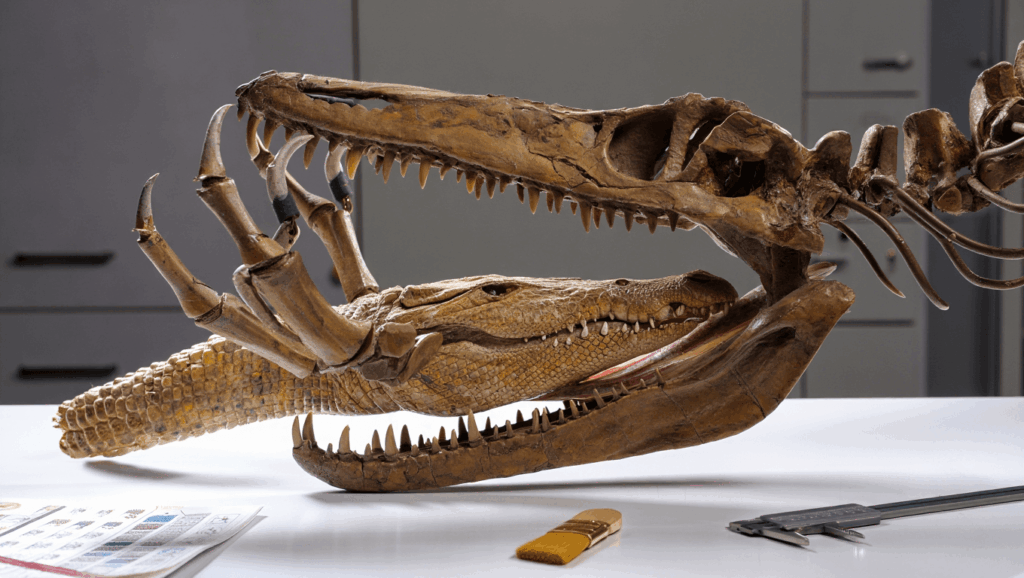
Scientists working in Patagonia have unveiled a startling fossil: a newly identified megaraptor whose remains include pieces of a crocodile ancestor wedged in its jaws. The discovery paints a vivid picture of a violent final moment for a top predator that once prowled South America, and it offers a rare, well-preserved look at a group of dinosaurs that paleontologists are only beginning to understand.
This animal wasn’t a small, movie-style raptor. At roughly 23 feet from snout to tail, the creature — now named Joaquinraptor casali — combined speed with formidable, blade-like forelimbs. Its fossilized skeleton is unusually complete for a megaraptor, and the presence of crocodyliform bone between its lower jaws hints that it may have died while eating or fighting, perhaps frozen in time by the catastrophic events at the end of the Cretaceous.
How the Patagonia Find Was Unearthed and Why It Matters
Researchers excavated one of the most intact megaraptor skeletons yet recovered from South America, a region that has yielded important but often fragmentary examples of this group. Because so few complete specimens exist, each new discovery can reshape scientists’ understanding of megaraptor anatomy, behavior, and evolution.
The Growing Demand for Data-Driven Decision Making in Silicon Valley
He quit, ran out of money, and begged to come back — here’s how his boss reacted
- Location: Southern Patagonia, a hotspot for Late Cretaceous fossils.
- Specimen condition: Among the most complete megaraptor skeletons found, preserving skull and limb elements.
- Scientific value: Provides crucial data on a poorly known clade of large theropods and their ecological roles.
Paleontologists estimate the individual’s age at about 19 years, yet indicators suggest it had not reached full adult size. That hint of youth combined with its large overall dimensions underscores how megatheropod life history differed from other predators.
Anatomy and Hunting Adaptations: Blade-Like Forelimbs and Speed
Megaraptors are not scaled-up tyrannosaurs. Instead of relying on crushing bite force and massive skulls, they evolved a different predatory toolkit: a lithe body built for pursuit and oversized, sickle-like manual claws adapted for slashing and gripping prey.
Key anatomical features of Joaquinraptor casali
- Length: about 23 feet (7 meters), rivaling other apex predators of its ecosystem.
- Forelimbs: elongated and robust with large, flattened claws on the first and second digits.
- Skull and jaws: preserved elements show a powerful, tooth-bearing snout suitable for tearing flesh.
- Locomotion: limb proportions consistent with a fast, active hunter rather than a slow ambush predator.
These adaptations suggest a hunting strategy that emphasized agility and slashing attacks rather than bone-crushing bites. Visual comparisons often evoke claw-wielding dinosaurs from pop culture, but the reality aligns more with functional anatomy: broad, strong manual unguals that could slice and hold onto struggling prey.
The Last Meal: Crocodyliform Bone Embedded in the Jaws
Perhaps the most dramatic detail: researchers discovered part of a crocodyliform limb bone lodged between the lower jaws of the specimen. The bone shows marks consistent with contact from the dinosaur’s teeth, indicating interaction shortly before fossilization.
Lucio Ibiricu of the Patagonian Institute of Geology and Paleontology, who worked on the specimen, told reporters that the position and condition of the crocodyliform remains make it plausible the megaraptor was consuming or fighting the crocodile ancestor when it perished. While this evidence can’t be said to prove a specific sequence of events beyond doubt, it is one of the strongest examples yet of a predator’s last meal being preserved in situ.
- Evidence observed: Crocodyliform humerus lodged amid mandibular bones.
- Bite marks present: Scratches and damage align with dinosaur teeth contact.
- Possible scenarios:
- Joaquinraptor was actively feeding on the crocodyliform when rapid burial occurred.
- The two animals were engaged in a deadly encounter at the moment of a catastrophic event (e.g., the K–Pg impact).
What Joaquinraptor Reveals About Late Cretaceous Ecosystems in South America
This discovery refines the picture of predator-prey dynamics near the end of the Cretaceous in Gondwana. In South America, megaraptors occupied top-predator niches without competition from tyrannosaurs, which were largely absent on those landmasses. That ecological gap allowed these theropods to evolve into dominant hunters with specialized forelimbs.
Researchers say the find helps address several open questions:
- How megaraptors diversified and spread across southern continents.
- How their feeding mechanics differed from other large theropods.
- What species composition and interactions looked like in Patagonian coastal and freshwater habitats.
The specimen also offers a rare snapshot into the chaotic final days of the Cretaceous. With direct evidence that a predator had recently interacted with crocodyliform prey at the time of death, the fossil provides a small but vivid window into life — and extinction — during an era of rapid environmental change.
You might also like:
- 90-million-year-old missing link fossil of tiny bird-like dinosaur discovered
- Pachycephalosaur skull upends understanding of dome-headed dinosaurs
- Ancient snake found in London museum: what we know
- Gobi Desert fossil discovery upends timeline of mammal evolution
- T. rex trackway in North Dakota: first adult 66-million-year-old footprints discovered

William Anderson is a multimedia producer specializing in videos, podcasts, and interactive galleries. With five years of immersive content creation, he turns information into a rich audio‑visual experience. His storytelling skills draw you directly into the heart of every story, on any platform.


Man, talk about a prehistoric power move! This megaraptor with a croc in its mouth is like the OG predator flex. Can you imagine stumbling upon that scene? Nature was metal back then, no doubt.
Dang, that megaraptor means business! Can you picture being face-to-face with that prehistoric power move? Its like watching a real-life Jurassic Park unfold. Nature was on some next-level stuff back then, no doubt. Bet those ancient peeps had to watch their backs 24/7!
Man, imagine stumbling upon a fossil with a crocodile in its mouth! That Megaraptor means serious business. Natures original gotcha moment. Wonder if the croc had any last thoughts like, Oops.
Man, imagine the drama if that ancient croc was still alive when the Megaraptor tried to chow down on it! Natures ultimate showdown! Wonder if theyll make a movie outta this wild prehistoric dinner.
Man, talk about a prehistoric power move! Imagine stumbling on a megaraptor fossil munching on an ancient croc like its a snack. Nature back then was no joke! Bet that scene would make a killer action movie.
Man, talk about a prehistoric power move! Megaraptor with a crocodile snack? Thats some next-level ancient drama. Can you imagine the chase? Nature was wild back then!
Man, imagine stumbling upon a fossil with a croc in its mouth? Thats like finding a time capsule of a prehistoric snack attack! Natures metal, man. Can you dig it?
Man, talk about a prehistoric power move! Megaraptor doesnt mess around, snagging a croc for a snack like its no big deal. Natures always full of surprises, aint it? Wonder what other wild discoveries are waiting to be dug up!
You know, finding a Megaraptor fossil with an ancient crocodile in its mouth sounds like the start of a prehistoric soap opera. Can you imagine the drama back then? Nature was really serving some wild plotlines!
Man, talk about a prehistoric power move! Megaraptor chomping on an ancient crocodile, thats some wild dinner drama. Wonder if its a case of bit off more than you can chew or just a raptor showing off its hunting skills. Natures always full of surprises!
Imagine stumbling upon a fossil with a crocodile in its mouth, thats like finding your sibling munching on cookies at midnight! Curious to know more about these ancient beasties and their wild dinner parties. Natures mysteries never fail to amaze.
I remember when I found a bug in my sandwich once… But a megaraptor with a crocodile snack? Natures got quite the dark humor. Can you imagine the chase? Talk about a prehistoric showdown!
Man, talk about a prehistoric power move! Megaraptors like, Ill have the croc as an appetizer, please! Finding fossils like this is like piecing together an ancient puzzle with some seriously wild twists.