
Show summary Hide summary
- How broadband ultrasound uncovers hidden defects in concrete
- Who built the system and where the research appears
- What the images tell inspectors and engineers
- Practical advantages over existing nondestructive tests
- Technical hurdles and next steps for field use
- Broader implications for infrastructure safety and asset management
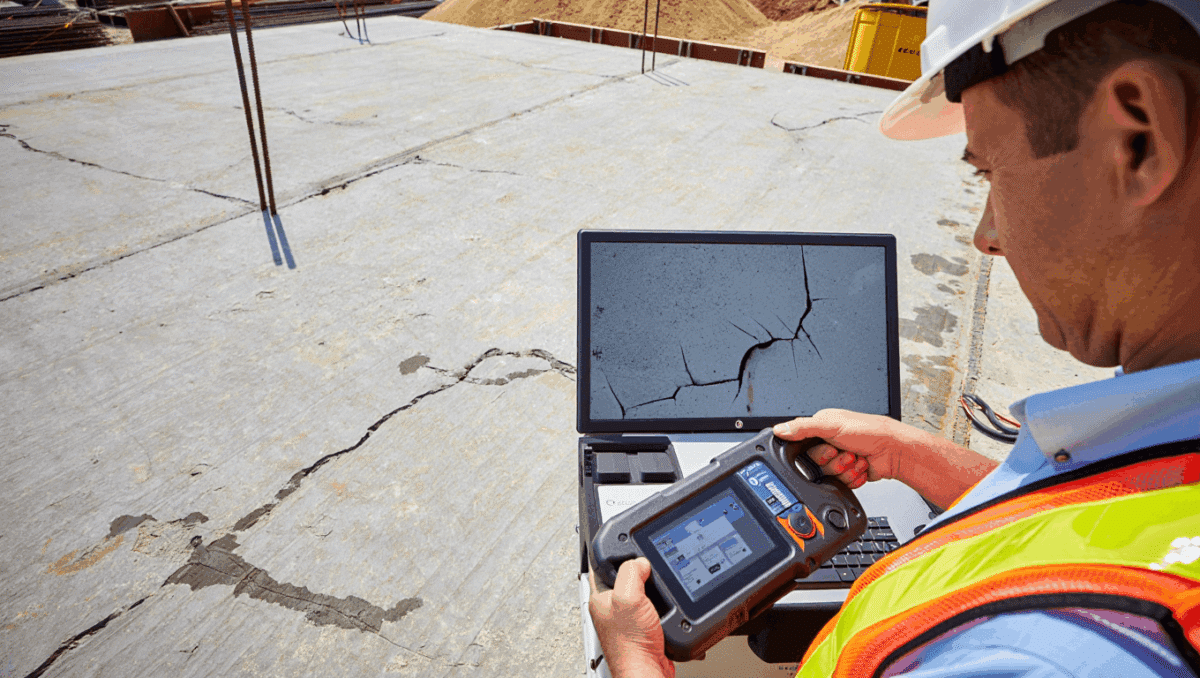
Concrete hides its flaws well. Where a doctor can order an quick ultrasound to reveal trouble inside a body, engineers have long struggled to image the hidden damage inside concrete—especially when that concrete mixes sand, slate, chalk, iron ore, and other materials that scatter sound. Now, a new ultrasonic imaging approach promises to peer inside slabs, columns, and bridge decks without breaking anything apart.
Developed by a collaboration of Japanese and American researchers, the technique combines a broad-spectrum sound source with a sensitive laser vibrometer to capture whatever ultrasonic signals survive the journey through heterogeneous concrete. The result: detailed, three-dimensional maps of internal defects that field crews can use to prioritize repairs and protect public safety.
How broadband ultrasound uncovers hidden defects in concrete
The Growing Demand for Data-Driven Decision Making in Silicon Valley
He quit, ran out of money, and begged to come back — here’s how his boss reacted
Conventional pulse-based ultrasonic tests work best in uniform materials. But concrete’s varied composition disperses specific frequencies and muffles echoes, making traditional single-frequency scans unreliable. The new system takes a different tack: it launches a wide band of ultrasonic frequencies into the structure and records the returning vibrations across that entire range.
By capturing all frequencies that make it through the mix of aggregates and binders, the system reconstructs clearer internal images than previous methods. Instead of guessing which frequency will survive, the instrument simply listens for whatever persists and uses those signals to generate a 3D view of the interior.
Why a laser Doppler vibrometer matters
- The system pairs a broadband ultrasonic emitter with a laser Doppler vibrometer, which senses surface vibrations caused by internal echoes.
- Because the vibrometer is broadband-capable, it records a wide spectrum of returning frequencies without swapping hardware or preselecting a narrow band.
- This adaptability reduces the need for manual tuning and increases the likelihood of detecting defects across many types of concrete mixes.
Who built the system and where the research appears
Researchers at Tohoku University in Japan led the effort with partners at Los Alamos National Laboratory and Texas A&M University. Their findings were published in the journal Applied Physics Letters, where the team detailed both the hardware configuration and imaging algorithms used to turn scattered ultrasonic energy into clear defect maps.
Professor Yoshikazu Ohara of Tohoku University described the advantage of a broad-frequency approach: by not relying on a single operating frequency, the method automatically adapts to the material’s filtering effects and boosts contrast between flaws and the surrounding concrete.
What the images tell inspectors and engineers
The primary output is a high-resolution, three-dimensional representation of an anomaly inside concrete. Important attributes that become measurable include:
- Depth from the surface to the defect
- Overall dimensions and shape of the damaged zone
- Orientation and spatial extent—how the defect runs through the structure
Those data points help maintenance teams plan targeted repairs rather than relying on invasive exploratory cuts or conservative replacements. Knowing the exact size and depth of a void, delamination, or crack saves time, reduces repair costs, and minimizes downtime for critical infrastructure.
Practical advantages over existing nondestructive tests
Several established inspection methods—like ground-penetrating radar, impact-echo, and X-ray imaging—have strengths in certain scenarios but also limitations when aggregates or reinforcements disrupt signal transmission. The broadband ultrasonic-vibrometer approach offers complementary benefits:
- Noninvasive imaging that doesn’t require drilling or coring
- Automatic frequency adaptation that reduces operator setup
- Improved defect contrast in heterogeneous concrete mixes
- Potential portability for on-site bridge and building inspections
Technical hurdles and next steps for field use
While lab results look promising, moving from controlled experiments to busy construction sites brings challenges. Environmental noise, surface access, and large-scale structures may require system refinements and robust processing software. The research team is focused on improving signal-to-noise performance and speeding up 3D reconstruction so technicians can get actionable results quickly on the job.
Adoption will likely follow pilot deployments on bridges, parking structures, and aging public buildings where timely, accurate nondestructive testing can reduce risk and extend service life.
Broader implications for infrastructure safety and asset management
Widespread use of advanced ultrasonic imaging could change how agencies manage concrete assets. Instead of relying on visual inspection and reactive repairs, owners could implement condition-based maintenance driven by detailed internal data. That shift would prioritize interventions where they’re most needed, potentially preventing catastrophic failures and saving public funds.
As infrastructure ages worldwide, tools that noninvasively reveal internal defects will be increasingly valuable for ensuring safety and optimizing repair budgets.
You might also like:
- Hedgehogs could avoid extinction with car-mounted silent ultrasound to prevent roadkill
- Jurassic insect chirps recreated: scientists simulate 165 million-year-old soundscape
- NASA laser sends terabits from beyond Mars in deep-space communications test breakthrough
- 3I/ATLAS alien search: scientists find no signs of alien life
- Osteoarthritis reversal within months: simple shot shows promise after animal trials

Michael Thompson is an experienced journalist covering U.S. and global news. With ten years on the front lines, he breaks down political and economic stories that matter. His precise writing and keen attention to detail help you grasp the real‑world impact of every event.


Man, imagine a concrete jungle with hidden defects waiting to strike. This ultrasonic wizardry is like having X-ray vision for buildings! Its like giving concrete a full-body scan, revealing all its secrets. Big Brothers watching… your foundation.
Wow, imagine a world where concrete can talk! Just kidding, but this ultrasonic imaging system is like concretes secret diary. Its like X-ray vision for buildings. So cool! Wonder how many secrets those walls are hiding.
Man, I remember when we had to rely on guesswork and luck to find those concrete defects. Now, with this ultrasonic imaging system, its like peeling back the layers of a concrete onion. Progress, huh?
Man, this ultrasonic imaging system for concrete defects is like having x-ray vision for buildings! Can you imagine the superpowers these engineers must feel, spotting flaws before they turn into disasters? Its like playing real-life detective but with lasers!
Imagine if our buildings could talk! This techs like giving concrete a voice to spill its secrets. Bet its making those sneaky defects sweat. No hiding now! Time to show your true cracks, Mr. Concrete!
Oh, the wonders of technology! Back in my day, we had to rely on luck to spot defects in concrete. Now, with this ultrasonic imaging system, its like having X-ray vision for buildings. What will they think of next?
Man, hearing about this ultrasonic imaging system for concrete feels like were in the future, right? Like, who knew we could detect deadly defects like that? Gotta hand it to technology, always surprising us with its cool tricks.
Man, back in the day, wed just knock on concrete to guess defects. Now, this ultrasonic wizardry is like having X-ray vision! Science is wild, man. Cant wait to see what they invent next!
Dude, I hear ya! Tapping on concrete sounds like ancient magic now. Its insane how far tech has come. Bet the inventors are cooking up some mind-blowing stuff! Who knows, maybe well have teleportation next, huh?
Man, concrete’s like a sneaky ninja, hiding defects until its too late. Bet this ultrasonic systems making engineers lives easier. Wonder how many aha moments theyve had seeing those hidden flaws pop up on the screen.
Concrete? More like concretely amazing! This ultrasonic wizardry is like having x-ray vision for buildings. Imagine the secrets those walls hide. Big Brother is watching, folks… through concrete.
I remember when my grandpa rambled about concrete quality like it was yesterday. This ultrasonic gadget wouldve blown his mind! Who knew tech could get this fancy for checking boring ol concrete? Bet hed still find something to grumble about, though.
I remember the time we had to knock on walls to check for defects like some kind of wannabe detective! This ultrasonic imaging system is a game-changer, no more playing Sherlock Holmes with concrete! Sounds like a concrete superhero in the making!
I used to work construction, man. Wish we had this ultrasound gadget back then. Wouldve saved us from all those hidden concrete defects. Better late than never, I guess. Techs movin fast!
Man, concrete just got a whole lot more interesting! I remember back in the day when inspecting it was like watching paint dry. Now weve got these ultrasonic systems doing all the heavy lifting. Whats next, talking buildings?
I once saw concrete crumble like a cookie under pressure. This ultrasonic thing sounds like a superhero for buildings, huh? Wonder if it can handle my landlords cheap fixes!